Built from the raw Japanese character stories, support card stories, career scenario (育成シナリオ), home screen lines, and the real-horse record. Every reading below is grounded in primary text, with the Japanese preserved where the wording carries weight that English translation destroys.
Thesis
A small child said that about her own suffering, and chose to keep it. Start there, because every colder and more famous thing about Mejiro Ramonu, the arrogance, the glacial beauty, the perfection no one can reach, grows out of the decision inside that line. Read her as a cold prodigy who happens to love racing and you are not wrong, exactly. You are looking at the top facet of a stone that has many, and mistaking one facet for the whole is the precise error the character is built to punish.
Turn the stone until the light goes through it:
Mejiro Ramonu is a girl who was denied racing at the formative moment of her life, and whose response was not bitterness but a love so total it permanently occupied the place where everything else, romance, friendship, comfort, ordinary ambition, would normally live. She chose, as a child, to keep the wound, because the wound is the love. Everything cold, distant, perfect, and frightening about her is the surface of that single fact.
Every facet below is that same fire seen from another angle: the perfectionism, the distance from people, the gemstone she is built around, the relationships she keeps, the way she paints, the way she wins, and, most importantly, the way she loses.
Part 1The Real Horse
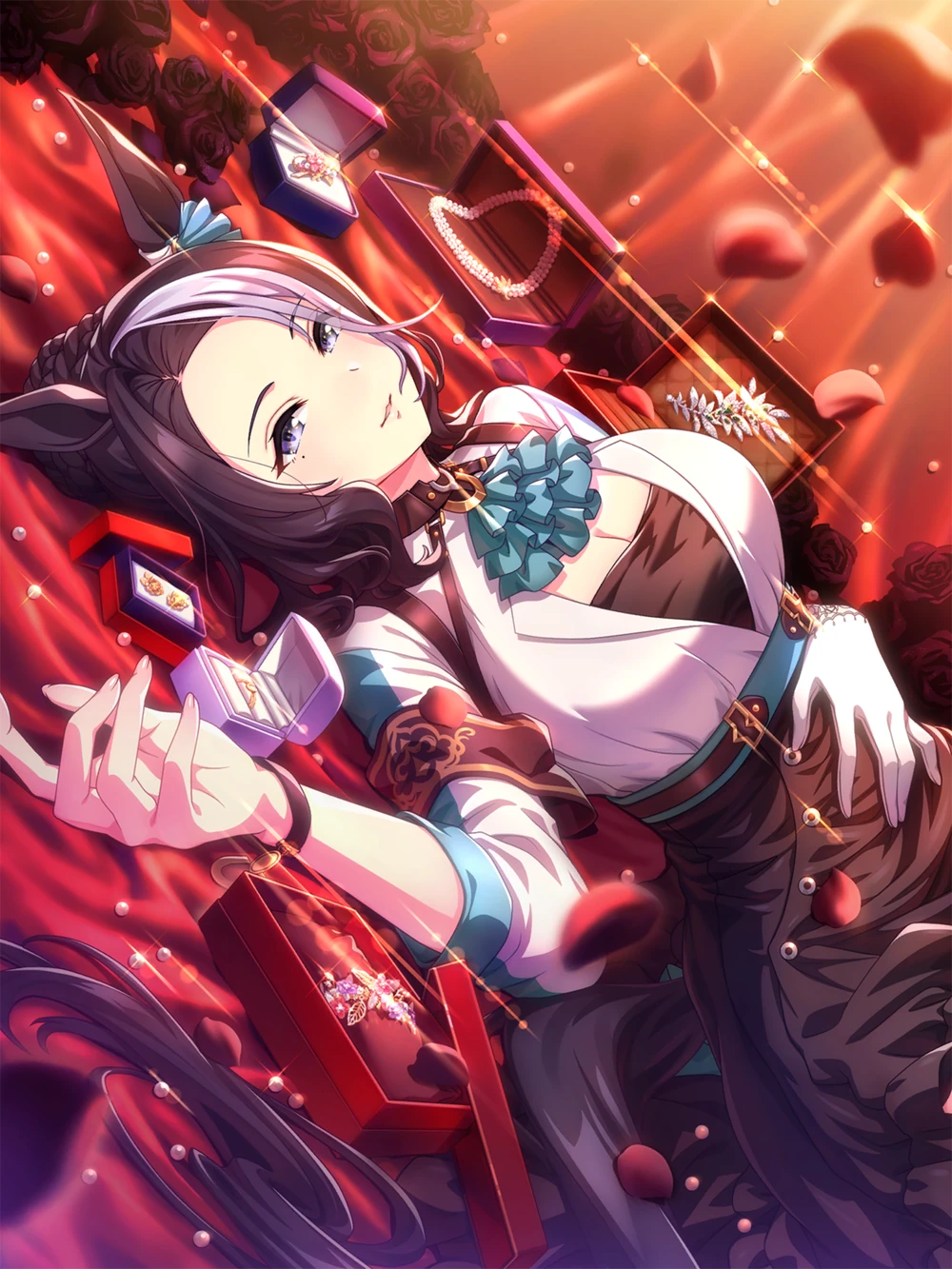
Ramonu’s writers did not invent her out of nothing. They read the real mare’s biography closely, and the psychology is built from what was already there in the record.
The headline facts: Mejiro Ramonu (メジロラモーヌ, 1983–2005) was the first filly in Japanese racing history to win the Triple Tiara, the Oka Sho, the Yushun Himba (Oaks), and the Queen Elizabeth II Cup, in 1986. Her career record was 12 starts, 9 wins, 0 seconds, 0 thirds.
That record shape matters more than the win count. Zero placings means she had no middle gear: when she won she won outright, and when she lost she lost completely. There was no “ran a good second.” She was either first or nowhere. For a character later built around the idea that anything less than complete love is not love at all, this is the biological seed, a horse whose own results refused compromise.
Two texture details the character preserves directly:
- The eating quirk. The real Ramonu had a constitution that gained weight extremely fast; when stressed by travel or disliked training her appetite would swing wildly, and she could eat many times more than other mares, after the Oaks her weight reportedly exceeded 500kg and had to be worked back down. The character turns this into philosophy (see Part 7): she eats meticulously because feeding the body is part of the act of loving.
- The pre-race anxiety. The real mare showed nerves before at least one race (the Queen Cup, which she lost while acting unsettled beforehand, her jockey said he couldn’t understand the defeat). The character keeps this high-strung sensitivity: her intensity is not serene control, it is a barely-contained volcano that can destabilize her when conditions are wrong.
One quiet, important detail: after retirement she produced twelve foals, none of which matched her, no G1 winners, no second Triple Tiara. Her greatness was specific, personal, and non-transferable. It belonged to her alone, not to a bloodline. This is why the character’s devotion is to racing itself rather than to legacy, dynasty, or what racing produces. The real Ramonu left a record, not a dynasty. The character loves the act, not the inheritance.
Part 2The Wound (The Flaw She Kept)
Every stone has an inclusion at its heart, and this is hers. Nothing else in the character makes sense without it, and it is almost entirely invisible in the English-translated material.
The facts
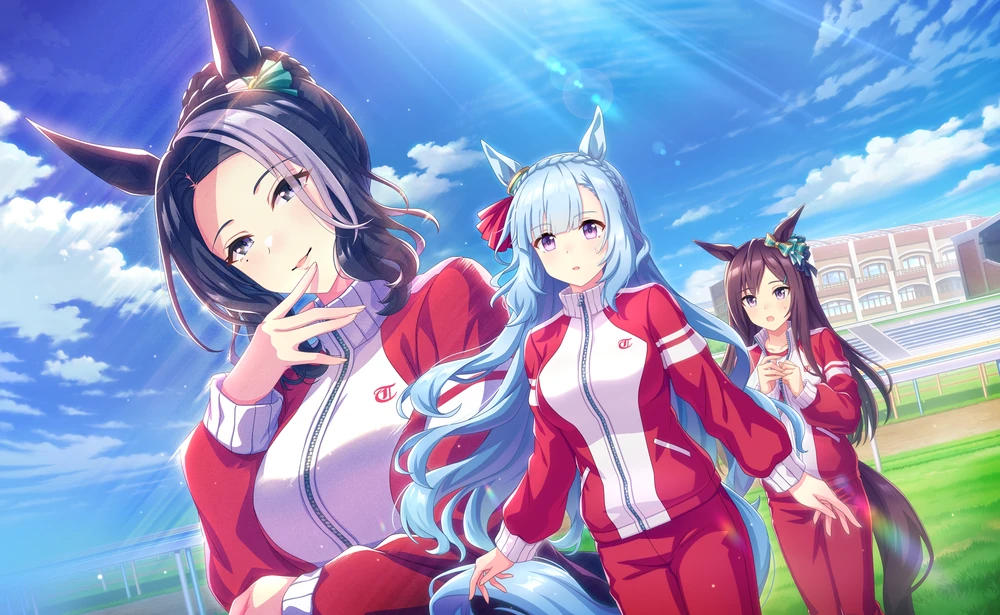
As a child, Ramonu’s legs were weak (足元に不安があり). Doctors weren’t sure she’d ever race. She was also physically frail in general, her sister Mejiro Ardan was sickly too, and the career story notes the two of them shared a sickbed as small children. During the Mejiro family’s annual winter training camp, the other children did snow training. Ramonu physically could not. So she sat alone in the lodge, watching them run through a window, and she painted.
The child’s own words
The career story does something the support cards only hint at: it lets adult Ramonu narrate her own childhood, and then drops directly into a flashback of the child herself. The progression is devastating.
Adult Ramonu, describing watching the others run:
「脚をさすりながら、他の子が大地を跳ねるのを……ただ眺めていたわ。」 “Rubbing my legs, I just watched the other children leap across the earth.”
「自由に、軽やかに、楽しげに……彼女たちの駆ける喜びは、眩しく迫ってきた。――眩しく。瞳の焼かれるほど。」 “Free, light, joyful, their delight in running came at me, dazzling. Dazzling enough to burn my eyes.”
Then the flashback to the child, and the writing visually breaks down to show a mind coming apart:
「『……走りたい』」 「『走りたい……走りたい、走りたい、走りたい、走りたい、走りたい走りたい走りたい走りたい走りたい走りたい』」 「『――……走るわ。でないと、この身は焼き尽くされる』」 "...I want to run. / I want to run, I want to run, want to run, want to run, want to run want to run want to run want to run want to run want to run / ...I'll run. Or this body will be burned to ash."
The spacing dissolves on purpose. This is not a child who wants something. This is a child being consumed by wanting it.
The choice to keep the wound
Everything she becomes is decided in one exchange. In a support card flashback, young Ardan asks about the abstract painting young Ramonu is making, and whether her sister is hurt. Ramonu, a small child, answers:
「わかるの。この痛みが消えたら、私は私でなくなる。灼かれ続けているほうがいい。待つわ……抱きしめにゆける日まで。」 “I understand it. If this pain vanishes, I stop being me. Better to keep being scorched. I’ll wait… until the day I can go and embrace it.”
Read what a child just said. Most trauma narratives are about healing a wound. Hers is the inverse: she looked at the wound and decided this is me, and I am keeping it forever. She is not in pain by accident. She consciously chose to stay burning, because the burning is the love, and the love is the self.
This is why even people who adore her find her 怖い, frightening. Ardan, recalling the scene, says she ran away as a child because her sister’s 情念 (passion/obsession) terrified her. The fear isn’t of cruelty. It’s of an intensity that decided, in childhood, that it would rather suffer forever than feel anything less.
Why perfectionism
The career story gives the cleanest possible statement of why she is a perfectionist. The Trainer says “you made an effort to run, didn’t you?” and she replies:
「努力……覚えがありませんわ。」 “Effort… I don’t recall any.”
She then lists what others would call effort, the medical examinations that drew blood, running a full day and night to find her limit until blood seeped under her nails, the rehabilitation that left blood on her palms, and dismisses all of it:
「いえ、やはり……どれも努力とはいえないわね。愛の流れ出るままにするほうが、ずっと苦しかったもの。」 “No, none of that counts as effort. Letting the love flow out as it pleased was far more agonizing.”
The bleeding wasn’t the suffering. Containing the uncontained love was the suffering. And then the line that explains the entire perfectionist personality:
「私は完璧を求めた……。不完全だったから。不完全では、愛せなかったから。」 “I sought perfection. Because I was incomplete. Because incomplete, I could not love.”
Her perfectionism is not pride and not discipline imposed on a love. It is the channel she carved so that an otherwise unbearable love would have somewhere to go. She fears incompleteness specifically because, once, incompleteness meant she could not love the thing she was dying to love. Perfection is how she earns the right to love.
Her perfection flickers. It is easy to misread her perfectionism as a craving for static, symmetrical flawlessness. It is the opposite. Her race outfit is deliberately asymmetric, mismatched gloves and stockings, and when asked why, she explains (愛は炎に似ている):
「完璧な愛は、炎に似ている。一瞬とて、同じ形をしていない……振れ幅があればこそ、マンネリズムは訪れない。停滞も枯渇もせず――完璧な愛を実現しつづけるために。」 “Perfect love is like flame. Never the same shape for a single instant. Only with variance does monotony never come. Neither stagnating nor running dry, so that perfect love keeps being realized.”
Her “perfection” is a living, flickering thing that must never stagnate (停滞) or run dry (枯渇). This is why she despised the technically flawless museum painting (Part 3): static, symmetrical, admired perfection is death to her. Real perfection has variance built in, like a flame. The asymmetry isn’t a lapse in her standards, it’s the standard. Perfection, for Ramonu, is not flawless uniformity; it is a love kept perpetually alive by never holding the same shape twice.
Part 3The Zoisite / Tanzanite Motif
The motif English translation erased completely, and the one that, once seen, organizes the entire character.
The gem
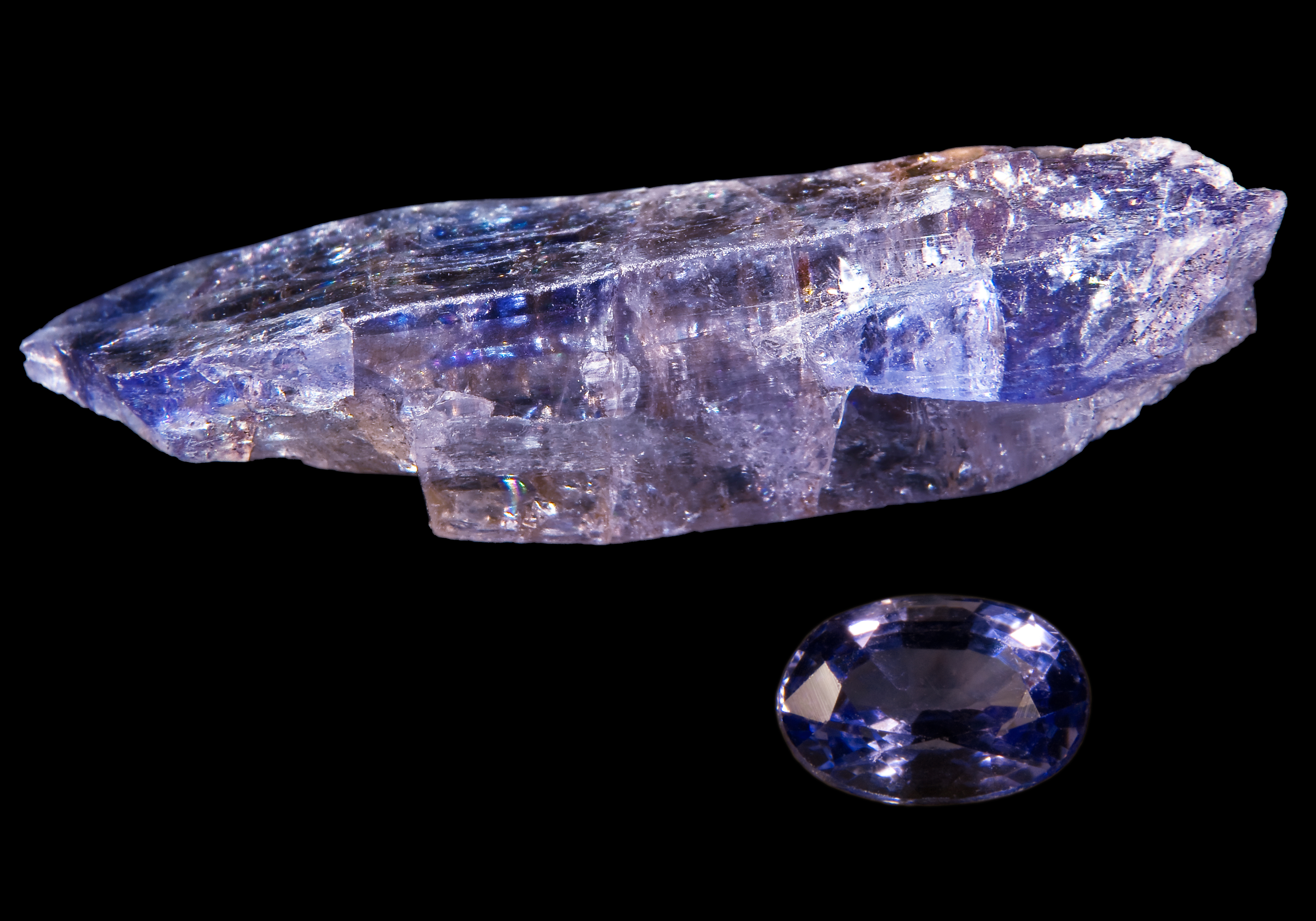
灰簾石 (kairenseki) is zoisite. Its violet-blue gem variety is tanzanite, the one famous gemstone whose signature color is exactly the violet-blue of Ramonu’s eyes (described in-text as 紫紺 and 薄紫). Her eyes are the stone. This is why Rudolf’s recurring warning works as a leitmotif rather than a one-off line:
「瞳に妖しい色が差している。そう――灰簾石のような。」 “A bewitching color shows in her eyes. Yes, like zoisite.”
He is naming the literal color of her stare and the danger inside it in the same breath.
Pleochroism, the structural key
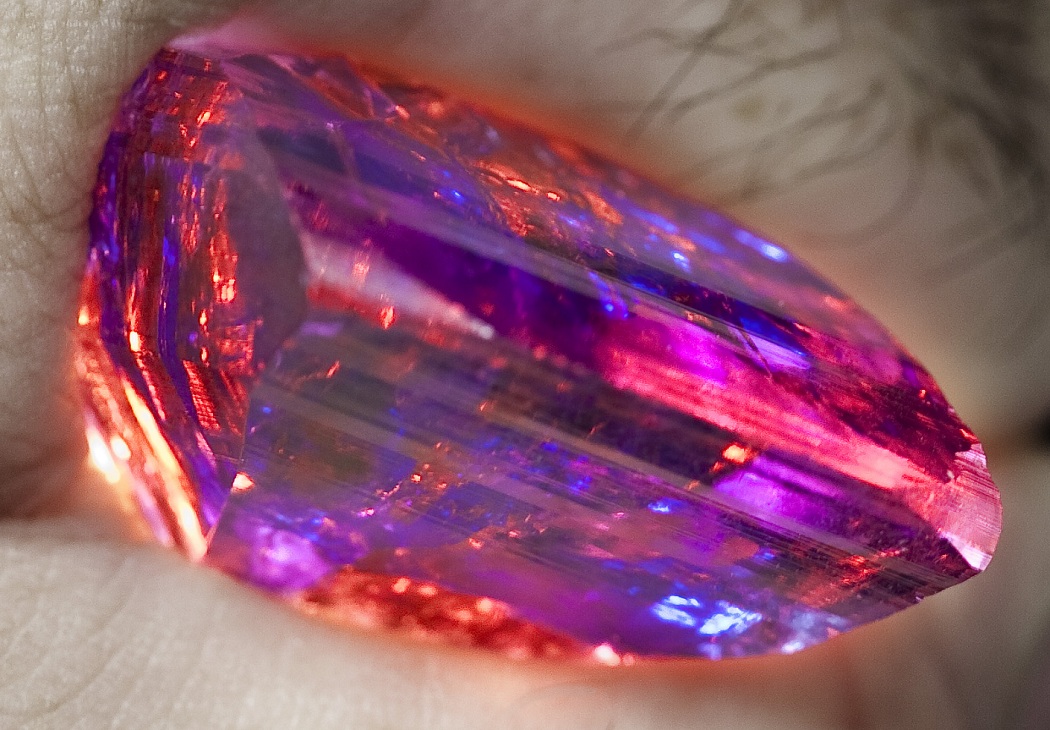
And the stone has one more property, the one that turns the motif from ornament into structure. Tanzanite is pleochroic: it shows different colors depending on the angle you view it from, violet, blue, sometimes burgundy. A single stone is several colors at once, and you can never see all of them from one position.
That is Mejiro Ramonu as a person, made literal in mineral form.
- The terrified students see a cold genius.
- Ardan sees something frightening.
- The magazine editor sees a jewel to be displayed.
- The museum crowd sees living art.
- The Trainer, eventually, sees the lover of the turf.
Every one of these is true. Every one is partial. No single viewing angle gives you the whole stone. The character is built on a gem whose defining property is “you cannot see all of me from where you stand.” Anyone who mistakes their one facet for the truth has made an error the story will eventually expose.
Gem-to-be-displayed vs. gem-that-runs
The story sets up “Ramonu as precious object” relentlessly, then has her violently reject it every single time. This is her central argument about her own nature.
The magazine arc: an editor’s entire concept is to shoot her as a jewel (宝石), posed among millions of yen of borrowed gems. She initially refuses, politely, devastatingly, and when she finally does the shoot, she detonates the premise from inside. She summons Rudolf with a single phone call, stages an impromptu race, and says:
「この私をショーケースに閉じ込めて……満足なさっては嫌ですわ。」 「必要なジュエリーは、蹄鉄と競走相手。あとはターフがあれば……この通り。」 「おわかり? この身ひとつで、十全なの。」 “Don’t you dare be satisfied locking me in a showcase. / The only jewelry I need is horseshoes and a rival. With a turf, like this. / Understand? This one body, alone, is complete.”
She takes a photoshoot designed to freeze her into a jewel and forces it into a race, because a gem in a case is a corpse to her. The result: the feature meant to display gems becomes 表紙から裏表紙までラモーヌ一色, cover to back cover, nothing but Ramonu. She didn’t pose as a jewel. She consumed the jewels.
A ring or a drill bit. A diamond in a ring exists to be looked at; a diamond on a drill bit exists to cut. Ramonu is violently on the side of the drill bit. A jewel’s worth, to her, is in what it does under pressure, not in how it photographs in a velvet box. The horseshoe is her jewelry. The rival is her setting. The turf is her display case, but a display case you move through at a full gallop, never one you sit still inside.
The museum scene, her aesthetic philosophy in one line
The climax of the zoisite cards. She looks at a technically flawless academic painting of a winged horse-girl and calls it 「ひどい絵」, a terrible painting. Why? Because it is beautiful and that is all it is:
「無知蒙昧にして、愛もない。」「善と美で、全てを語り尽くした気でいる。」 “Ignorant, and loveless. It thinks it has said everything with goodness and beauty.”
Beauty that exists only to be looked at, with no love driving it, is a corpse wearing a crown. This is exactly why she rejects being shot as a jewel: prettiness without love is a lie that believes itself complete. She is a stone that refuses to be admired and insists on being used.
Part 4Painting as Language
For Ramonu, painting and racing are not two hobbies. They are the same act in two mediums, and painting came first because it was the only one available during the years she could not run.
Phase 1, painting as substitute (the wound years). Stuck in the winter lodge, she hurled her 気炎 (fighting spirit), 陶酔 (intoxication), 焦熱 (burning heat), and 憂鬱 (melancholy) onto abstract canvases. The paintings weren’t pictures of things. They were the raw emotional charge of wanting-to-race with nowhere to go. Painting was racing’s prosthetic limb, the only way she could “touch” the thing behind the glass.
Phase 2, the two fuse. As an adult who can now run, she keeps painting, and states the unification outright while sketching the Trainer:
「完璧なタブローは、完璧な習作から。情熱だけでは、愛もエゴになり果てる。レースと、同じ。」 “A perfect finished painting comes from perfect studies. Passion alone makes even love degrade into ego. Same as racing.”
The discipline of art (studies before the masterpiece) and the discipline of racing (perfect preparation before the perfect race) are the same principle: love without rigor curdles into ego. She is not a racer who also paints. She is a person with one philosophy of love expressed through two channels.
Phase 3, painting as how she reaches the beloved. The most revealing line, from a support card:
「あの頃には、遠く及ばない。けれど、それもそうよね――今は、私の愛に会いに行けるのだから。」 “I can’t come close to what I painted back then. But of course, because now I can go and meet my love directly.”
Her current painting is worse than her childhood abstractions, and she knows it. Why? Because back then, painting carried the entire crushing weight of total deprivation, all the desperate charge of a love that had no other outlet. Now she can just go race, so painting no longer has to bear that whole burden. The childhood paintings were more powerful precisely because they were made by someone who could not have the thing. Deprivation was the pigment. This is the same logic as the entire character: the love was strongest when it was denied.
And the detail that records her healing without a word: after she leaves the lodge in one scene, the maid finds on the canvas 青々とした新緑, fresh green shoots, new growth. The girl who once painted only burning heat and melancholy now leaves green sprouts, because she is no longer starving.
Phase 4, the “history of love” decision. The flawed childhood painting resurfaces, and she agonizes over whether to retouch it into something technically better. The Trainer suggests it is a 「愛の歴史」, a history of love, and should be left as it is. Her conclusion:
「過去は過去。描くべきは……今の愛、だわ。」 “The past is the past. What I should paint is the love of now.”
For a perfectionist whose identity is “I only offer perfect things to my love,” choosing to preserve an imperfect work should be a violation of everything she stands for, except it isn’t, because the childhood painting is not a flawed artwork. It is a record of when the love was young and hurt. Fixing it would erase the wound, and 「この痛みが消えたら、私は私でなくなる」, if the pain vanishes she stops being herself. She keeps the imperfect painting for the exact same reason the child chose to keep burning. The painting and the wound are the same thing, preserved on purpose.
The races are her love alive, visible for two minutes, then gone. The paintings are her love’s archive, held still, layered, including the version that existed before she could run. That she still paints, though she can now race, is proof she never abandoned the girl in the lodge. She carries that child forward in every canvas.
Part 5The Nature of the Love (Why “Dommy Mommy” Is the Wrong Read)
The fandom has reduced her to a domineering seductress, and it has her exactly backwards.
The career story is relentless about what kind of love this is. It is not abstract affection for a sport. It is the precise language of a lover approaching a beloved’s body:
- Her debut race is 「初めてのデート」, “my first date.”
- The pre-race trembling the Trainer mistakes for nerves is the joy of getting to love: 「これからレースを愛する、喜びから」.
- 「ずぅっとなぞりたかった、愛する肌に」, “the beloved skin I’ve always wanted to trace.”
- 「口づけしたかったのよ。勝利に――」, “I wanted to kiss it. Victory.”
- After a race: 「もう、いつでも、愛撫できるんだわ」, “now I can caress it anytime.”
Racing does not resemble a romance for her. It occupies the exact psychological and emotional slot that a consuming romantic and sexual love occupies in other people. This is why she has no room for an actual romance with any person: the slot is permanently, completely, monogamously filled by the act of racing.
So the “dommy mommy” reading inverts her. It sexualizes Ramonu as an object of desire, when the actual text has her entire sexuality sublimated into the turf. She is not a dominant toying with admirers. She is a woman in a total, lifelong love affair with running, who barely registers the people projecting desire onto her because her own desire is already and forever spoken for. The eroticism in the text flows from her toward racing, never the reverse. Reducing her to a fetish archetype is precisely the “jewel in the showcase” error she spends her whole story rejecting.
Part 6The Relationships
Symboli Rudolf, “Loulou,” and the lover she’ll never meet again
The relationship that means the most and shows the least.
The foundation is childhood and dynasty. The Symboli and Mejiro families share 古くからの約束, an old promise. Rudolf, Ramonu, and Sirius grew up entangled in it. Rudolf achieved the Classic Triple Crown; the Triple Tiara is framed as “your turn, Ramonu.” And the perfect-route confirms what the support cards only implied: Rudolf and Sirius knew the girl behind the glass, before there was a jewel to look at. In the 王道 route Rudolf recalls the three of them picnicking as children, “Rudolf and Sirius would run off, and you…” (he stops: “no, you don’t remember”). Ramonu’s own answer:
「忘れていない。木陰から眺めていた、あの日のこと。高らかな笑い声……耳に貼りついている。」 “I haven’t forgotten. That day, watching from the shade of the tree. The high laughter still clings to my ears.”
The two Symbolis ran and laughed in the sun while child-Ramonu watched from the tree-shade, unable to join. They are the witnesses to the wound. Everyone else meets the finished stone and gets one facet; Rudolf and Sirius knew the raw mineral before it was ever cut. That is the concrete shared image underneath the “Loulou” intimacy, and underneath the grief in the next beat.
“Loulou.” After Rudolf solemnly says she prays Ramonu’s love comes true, Ramonu laughs:
「ふふっ……あははっ……ああ、おかしい。そういうところよ、Loulou?」 “Ahaha, that’s funny. That’s exactly your problem, Loulou.”
A French diminutive, written in the original script in Latin letters, the writers reaching for French deliberately, fitting her register of refinement (tableau, croquis, her name from the Alpine peak l’Amône). It is almost certainly a soft baby-talk warping of “Rudolf,” the way “Robert” becomes “Bobby.” Nobody else on Earth calls the Emperor, the figure who makes Ramonu’s own aura look approachable, a cutesy French pet name and teases her. The line just before is Rudolf saying “don’t treat me like a child”; Ramonu’s whole demeanor answers but to me, in this one way, you are. That is the intimacy of someone who knew you before the crown.
The philosophical fault line. They are genuine opposites. Rudolf races for something, the cause, the role, the dynasty, the meaning; the crown is the point. For Ramonu the crown is a byproduct of loving, and chasing it as the goal would corrupt the love (成就を願えば、それは愛ではなくなる, “if you wish for fulfillment, it stops being love”). To Rudolf, racing serves duty. To Ramonu, duty is an accidental side effect of love. They are the same dynastic obligation viewed from opposite religions.
The wound, “皇帝の決断.” This is the deepest beat of the relationship, and it is the one place Ramonu visibly cracks. Rudolf retires from racing to become an administrator, choosing to serve the sport from outside the turf, before she and Ramonu ever get their dream head-to-head. Ramonu’s reaction, which the Trainer notes is unbecoming of her and tinged with something like rejection:
「もう二度と会えない恋人……とでも、言ってしまえばいいのに。」 「ターフの中と外で、どうして交われるの?」 “‘A lover I’ll never meet again’, she could just come out and say it. / How can the inside and outside of the turf ever intersect?”
To Ramonu, who can only love on the turf, Rudolf choosing the cause over the chase is a form of abandonment indistinguishable from a lover leaving. The “Loulou” intimacy is real, and this is its cost: the one childhood friend who knew the stone before it was cut chose duty, stepped off the turf, and became, in Ramonu’s own words, a lover she will never meet again. It is the closest she comes in the whole story to grief.
Mejiro Ardan, the sister, and the human cost
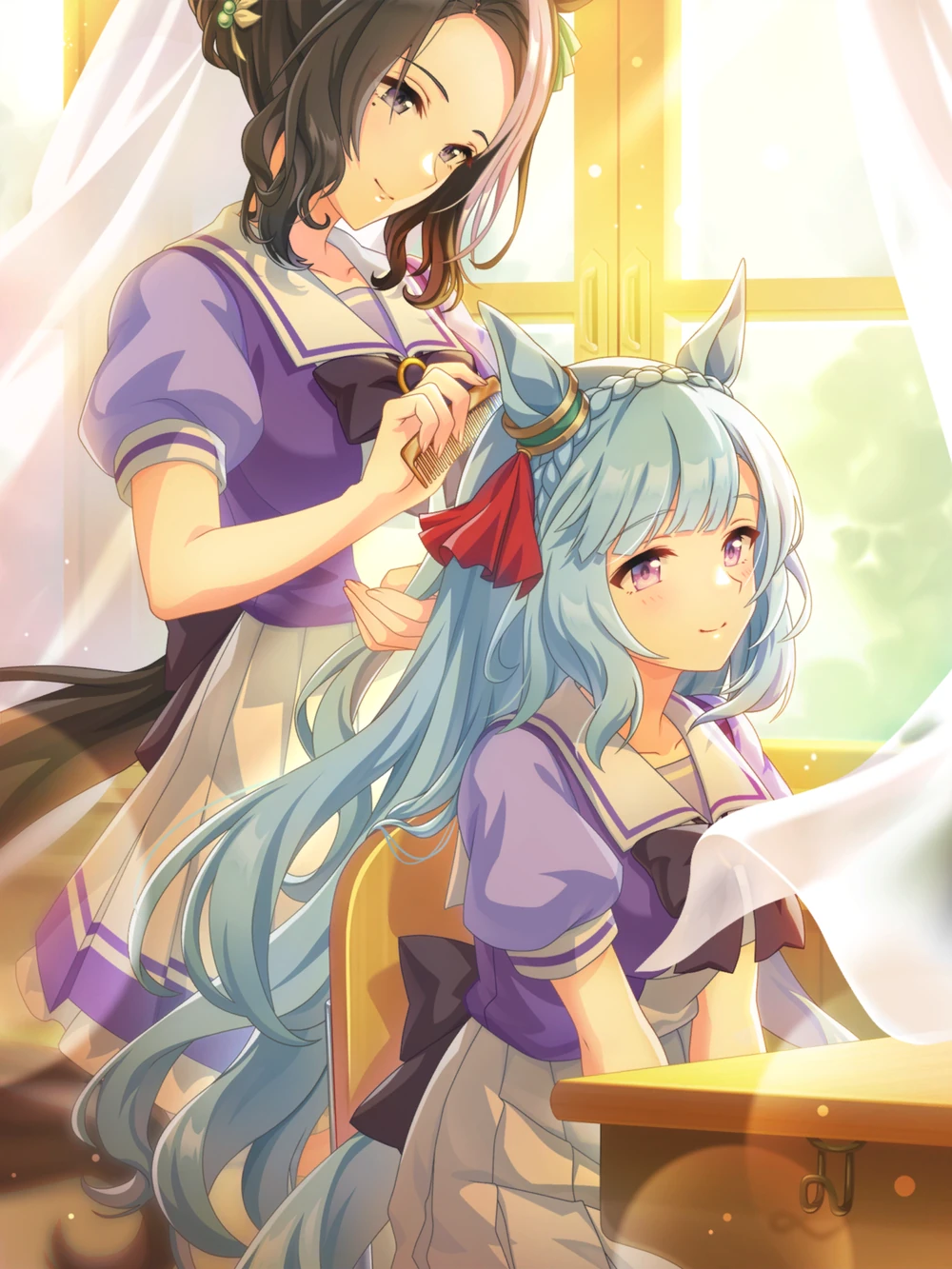
Ardan is the devoted younger sister who narrates much of Ramonu’s backstory and clearly worships her, 「私、姉様の走りが好きなんです」 (“I love my sister’s running”). They shared a sickbed as frail children.
But the normal ending delivers the quiet, important bruise. The trainee Mejiros all come to the Trainer to learn about Ramonu, and Ardan says:
「……少し、悔しいです。私のほうが、姉様との時間は長いのに!」 ”…I’m a little frustrated. I’ve spent far more time with my sister than you have!”
The sister who shared a sickbed with her, who worships her, is jealous that a Trainer of three years can approach Ramonu in ways she cannot. This is the price of loving someone who lives inside a sealed world. Ardan pays it quietly, for life. The study would be hagiography without this: Ramonu’s completeness imposes a real, unfair cost on the people closest to her, and the writers do not pretend otherwise.
Nishino Flower, the rival who can only be seen by beating her
The most underrated thread in the entire scenario, and the one that reframes Ramonu from the outside.
The recurring “white-decorated horsegirl” through the Classic arc is Nishino Flower, small for her generation, skipped a grade into the academy, and who copied Ramonu’s head decorations out of admiration. All she wants is to be acknowledged as a rival. Her refrain:
「……届かない。だって、完璧すぎる。あのひとには……何も。想いも、脚も……届かないんだ――」 “I can’t reach her. She’s too perfect. Nothing reaches that person, not my feelings, not my legs.”
Nishino Flower is the audience-surrogate for everyone who experiences Ramonu as an unreachable wall. And the devastating turn: in the Oaks, she pushes Ramonu to a defeat, and her reaction is shock at how ferociously Ramonu fought from a hopeless position:
「なんて、気迫……もう、届かないはずなのに……どうして……! あなたは……“そう”なの……っ! メジロラモーヌ……!」 “Such ferocity… you shouldn’t be able to reach anymore… why…! You’re ‘that’ kind, aren’t you, Mejiro Ramonu!”
The rival finally sees her, not the perfect jewel, but the desperate, burning lover who will claw forward from a lost position. The one who gets closest to Ramonu is the one who beats her, because defeat is the only thing that makes Ramonu show the wound in public. And Nishino Flower pays for that closeness with an entire arc of painful, unrequited rivalry, straining to be noticed by someone who barely registers her. The cost again, real, and unsugared.
The Trainer, the one who accepts the seal
It is tempting to read the Trainer as the man who finally “gets inside” Ramonu’s world. The text is more honest and sadder than that.
The contract begins arbitrarily: she signs with him only because he happened to be the first to approach her after she debuted (「きっと、誰でもよかったのだろう」, “surely anyone would have done”). Several trainers preceded him; none could endure a person for whom only racing and herself exist.
And by the end, he still hasn’t cracked the seal. The other Mejiros come to him to understand her, yes, but Ramonu’s own instruction for how to understand her is, still, go watch her race:
「私の全ては、蹄鉄で描いている。なぞれば浮かぶ……後はどうぞ、お好きに。――この愛の一部でも、辿れるものなら。」 “My everything is drawn in horseshoes. Trace it and it surfaces, then do as you like. If you can follow even a part of this love.”
He does not reach her. He becomes the one person who accepts that she can only be reached at a full gallop, and loves her in the only language she has, the turf. That is the resolution: not “he unlocked her,” but “he learned to stand beside someone who cannot be unlocked, and stopped needing to.” The earlier arbitrariness is answered not by him becoming special to her in a conventional way, but by him being the one who stopped demanding she be reachable.
Part 7The Eating Quirk, Resolved Into Philosophy
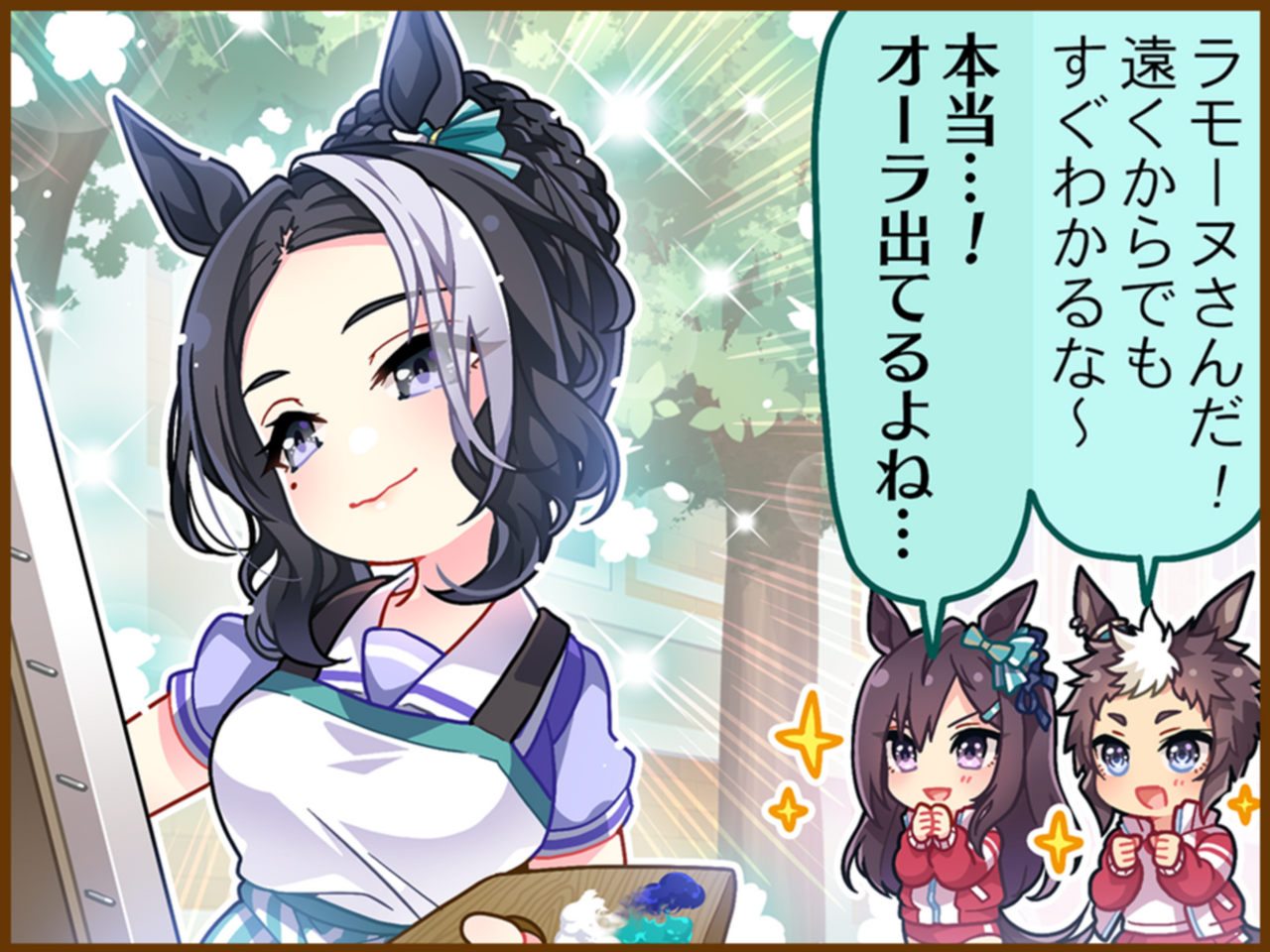
A small thread that shows how completely the writers fused the real horse with the character. The real Ramonu’s wild appetite becomes, in a home-screen line, a piece of devotional logic:
「愛する行為は、生気を注ぐこと……体が飢えてしまわないように、食事で満たしておかなければ。」 “To love is to pour in life-force. So that the body does not starve, it must be filled with food.”
And on the resort day-trip:
「血肉になるものは吟味しなければ。ターフの上には、この身1つで臨むのだから……。妥協ができるものを、私は愛とは呼ばない。」 “What becomes flesh and blood must be scrutinized. On the turf, I face it with this one body alone. I do not call what can be compromised love.”
The gluttony anecdote of the real mare becomes: she eats with rigor because the body is the instrument of the love, and a compromised instrument is a compromised love, which by her definition is not love at all. Even meals are conscripted into the one devotion.
Part 8Win or Lose, She Does Not Change (The Real Proof)
The career story answers the question the support cards alone could not: does she develop, or is she a fixed star? The answer comes not from any single race but from comparing the branches, and it is the strongest evidence in the whole study for the non-teleological love.
First, how the scenario is built, because the proof depends on it. Each Tiara race in the scenario has multiple branch outcomes depending on how the in-game race goes: two win variants (a grander win and a standard win) and a lesser/defeat variant. So there is no single “canonical” result, the player’s performance decides whether she sweeps cleanly or falls short. This is exactly why the branches are so revealing: we get to watch the same character react to opposite results, and see what stays constant.
What stays constant is everything that matters.
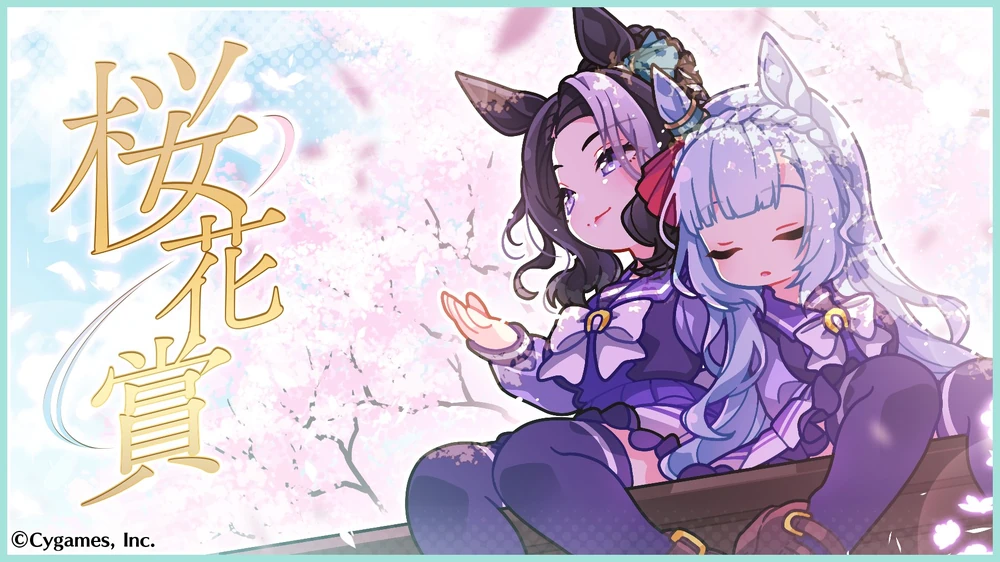
In the win branch (the Oka Sho’s 桜花爛漫), she does not celebrate the crown. She narrates the sensation and immediately turns toward the next race:
「一斉に……咲き誇る。――桜の如く。……散っても、忘れないわ。さあ……樫の花は、どれほど重く垂れさがるのかしら。見ものね……。」 “All at once, they bloom in full glory. Like cherry blossoms. Even when they scatter, I won’t forget. Now, how heavy will the oak blossoms hang, I wonder. How I look forward to it.”
In the defeat branch (the Oaks’ 樫は堅く), pushed hard by her rival, she says, not to the Trainer, but to racing itself and the rival who drove her:
「貴方だけよ。こんなに……私を、狂わせるのは。……本当に、愛してるのよ。見て……私を。ただ貴方に駆ける、私を……。」 “It’s you alone. The only one who drives me this mad. …I really do love you. Look at me. Me, running just for you.”
Turn the result either way and the color holds: the result barely changes her. Win gloriously, and she’s already in love with the next race. Fall short, and the love only intensifies, because falling short means racing is bigger than she is, which means there is more of it to love. In both branches she smiles, names the sensation, and wants more. The crown is not the variable. The love is the constant.
This is foreshadowed before the Oka Sho, when the Trainer says “let’s definitely get the Triple Tiara!” and she replies:
「とれなくったって、いいのよ。……もちろん、その玉座に私はいるでしょうけれど。”トリプルティアラがとれなければ、全て終わり”……なんて、顔はなさらないで。この愛が、そのために涸れることは決してないもの。トリプルティアラは、あくまでも家のため……愛を証明するため。私の愛、そのものではない。」 “It’s fine even if I don’t get it. …Of course, I’ll be on that throne anyway. But don’t make a face like ‘if we don’t get the Triple Tiara, everything is over.’ This love will never dry up for that. The Triple Tiara is only for the family, to prove my love. It is not my love itself.”
This is the love that wants nothing back, set down as doctrine rather than dropped as an aside. The goal is explicitly demoted. The crown is a gift to her family and a proof, never the love. She would love racing exactly as much if she lost every race, and the branch structure demonstrates this rather than just asserting it. So she is a fixed star: not one whose nature changes under pressure, but one whose light reads the same from whatever angle the result leaves you standing. That is also the final refutation of any “arrogant prodigy who only cares about winning” reading, the writers built the proof directly into the scenario’s branches.
And in case the branches leave any doubt, the perfect-route narration says it outright. When the Trainer celebrates a record-shattering achievement, the game itself narrates:
「メジロラモーヌは至高のレースを走り、それに勝利することを至上の愛としている。記録そのものに固執しているわけではない。」 “Mejiro Ramonu holds running the ultimate race and winning it as her supreme love. She does not fixate on the records themselves.”
Not inferred from her behavior, stated by the narration. The record is a byproduct. The race is the beloved.
When she does complete the Tiara, the moment is deliberately anticlimactic. She does not celebrate. She just smiles and narrates the sensations:
「空気を震わす――熱狂。肌に突き刺さる――絶叫。そして……迸る――愛。」 “Fervor that shakes the air. Screams that pierce the skin. And then, surging, love.”
The achievement is nothing. The feeling of the race is everything. She has already moved past the crown to wanting the next one, 「愛したい……」 (“I want to love…”).
Part 8½She Hunts the Strongest, and Manufactures Her Own Longing
Two threads from the perfect-route and the Desire card sharpen how the love propels her forward, and both trace straight back to the wound.
She seeks out the greatest possible rival the instant she conquers a peak. Both perfect-route branches end identically: the moment she completes a path, she stages an unofficial, off-record race against the strongest opponent available, Maruzensky for the mile, Rudolf and Sirius for mid-distance, framed as a “celebration.” To Maruzensky she says she’s come 「本当のマイルの頂点を、いただきに参りましたわ」, “to take the true summit of the mile.” And the love has a target: she does not love racing as an abstraction, she hunts the strongest rivals specifically, because a greater opponent is a greater love and a more perfect race. The records mean nothing to her (Part 8); the quality of the contest means everything. A rival who can push her is the most precious thing she can be given, which is exactly why Sirius offering 「敗北の味を、祝儀に教えてやる」 (“I’ll teach you the taste of defeat as a congratulations gift”) is, to Ramonu, a genuinely generous present.
When the beloved is taken away, she deepens the love on purpose. The Desire card: a night race she was looking forward to is cancelled. Instead of disappointment, she goes alone to the empty floodlit track at night to acclimate her skin to the night air for next year, and explains:
「会えないならば、募らせるのよ。胸を刺す切なさも、泥のような懊悩も。逢瀬を引き立てる調味料……期待と焦燥を絡ませて、この胸で丹念に醸すの。」 “If I can’t meet it, I let it build. The piercing ache, the mud-thick anguish, they’re seasoning that heightens the tryst. Weaving expectation and impatience, I brew it carefully in my chest.”
This is the childhood deprivation mechanic, now running by choice in adulthood. As a child, being kept from racing forced the longing that forged her love. As an adult, when racing is briefly withheld, she recreates that deprivation deliberately, because she learned in the snow lodge that distance and waiting concentrate the love rather than diminishing it. She doesn’t fear being kept from the beloved. She knows how to use it. It is the clearest possible proof that the wound was never something she recovered from, it is a tool she kept, and still wields.
Part 9The Through-Line (Synthesis)
Put every part together and the whole stone resolves:
Mejiro Ramonu was denied racing at the formative moment, and her response was not bitterness but a love so total it permanently took the place where everything else in a person, romance, friendship, comfort, ordinary ambition, normally lives. She chose, as a child, to keep the wound, because the wound is the love and the love is the self: “if this pain vanishes, I stop being me.”
She pursues perfection not from pride but from fear of incompleteness, because once, incompleteness meant she could not love the thing she was dying to love. Perfection is how she earns the right to love.
The Triple Tiara is a gift to her family and a proof of love, never the love itself, which is why the result barely moves her: she wins and reaches for the next race, she falls short and the love only deepens, because either way the crown was never the point.
She is a tanzanite that refuses the showcase and demands to be run: a jewel whose worth is in motion and love, not in being admired, and whose pleochroic nature means no one ever sees the whole stone from where they stand.
And the people around her pay for this completeness: the rival who can be seen only by beating her, the sister who can’t be as close as a stranger, the childhood friend who chose duty and became “a lover she’ll never meet again,” the Trainer who had to give up reaching her and learn to stand beside her instead.
She is loved by everyone and reachable by no one, and she made that trade knowingly, in a snow lodge, as a child, because the only thing she cannot survive is loving the turf any less than completely.
The cold prodigy, the domineering beauty: each was one facet, seen from where somebody happened to stand. The stone itself is a girl who turned a deprivation into a devotion so absolute that it became indistinguishable from who she is, and who decided the burning was worth it.
「成就を願えば、それは愛ではなくなるわ。ただ愛するのよ、一途に……果てなく。」 “If you wish for fulfillment, it stops being love. I just love, single-heartedly, endlessly.”
Appendix, Lines Worth Keeping
The facets worth holding up to the light, with sources.
| Line (JP) | Translation | Source |
|---|---|---|
| この痛みが消えたら、私は私でなくなる。灼かれ続けているほうがいい | If this pain vanishes I stop being me. Better to keep being scorched | Support card (childhood flashback) |
| 私は完璧を求めた……不完全だったから。不完全では、愛せなかったから | I sought perfection because I was incomplete. Incomplete, I could not love | Career, Grandmother chapter |
| 愛の流れ出るままにするほうが、ずっと苦しかった | Letting the love flow out as it pleased was far more agonizing | Career, Grandmother chapter |
| 成就を願えば、それは愛ではなくなるわ。ただ愛するのよ | If you wish for fulfillment it stops being love. I just love | Support card (Rudolf) |
| トリプルティアラは……家のため、愛を証明するため。私の愛、そのものではない | The Triple Tiara is for the family, to prove my love. Not my love itself | Career, pre-Oka Sho |
| 貴方だけよ。こんなに私を狂わせるのは……本当に、愛してるのよ | It’s you alone who drives me this mad. I really do love you | Career, Oaks (defeat branch) |
| 必要なジュエリーは、蹄鉄と競走相手。この身ひとつで、十全なの | The only jewelry I need is horseshoes and a rival. This one body is complete | Support card (magazine) |
| 瞳に妖しい色が差している。そう、灰簾石のような | A bewitching color shows in her eyes, like zoisite | Support card (Rudolf) |
| もう二度と会えない恋人とでも言ってしまえばいいのに | She could just call it ‘a lover I’ll never meet again’ | Career, Emperor’s Decision |
| 私の全ては、蹄鉄で描いている | My everything is drawn in horseshoes | Career, Normal Ending |
| 記録そのものに固執しているわけではない | She does not fixate on the records themselves | Career, perfect route (narration) |
| 忘れていない。木陰から眺めていた、あの日のこと | I haven’t forgotten. Watching from the tree’s shade, that day | Career, 王道 route |
| 完璧な愛は、炎に似ている。一瞬とて、同じ形をしていない | Perfect love is like flame. Never the same shape for an instant | Random event, 愛は炎に似ている |
| 会えないならば、募らせるのよ | If I can’t meet it, I let it build | Support card, Desire |
| 愛と食は通じている | Love and food are connected | Random event, 根源たるもの |
Translations are working renderings aimed at preserving meaning and register; the Japanese is the authority.