Thesis
Mejiro Ardan was born a twin. The other was stillborn, and by the old racing superstition, 双子は大成しない, twins never amount to anything, the survivor inherits the verdict too. So before she could stand, she had already been handed two sentences: a dead sibling, and a rule that said she would fail. The reading everyone reaches for from here is the fragile, brave girl who races anyway, and it is true. It is also only the surface. What she is actually made of starts at that birth: a body that physically cannot do the one thing she wants, and a decision, made with the cost fully in view, to charge at it anyway.
Glass hides nothing, so look straight through:
Mejiro Ardan is a horsegirl born with a body that physically cannot do the thing she wants, who looked at that fact clearly, the prognosis, the cost, the likelihood of breaking, and chose to charge anyway, knowing exactly what it would cost. She is not fearless. She is the harder thing: courageous. And the philosophy she builds on top of that choice is, at the structural level, the behavior of glass itself, a thing with no give, that holds its shape absolutely or shatters absolutely, and never, ever bends to save itself.
Everything about her, the serenity, the elegance, the living-only-in-“now,” the refusal to retreat, the way she relates to rivals and to her trainer, flows from a single decision: that a brief, certain blaze of light now is worth more than a long, safe life that never burns. Every part below follows that decision outward, down to the very end, where the one thing she could never afford, a future, is given to her, and she chooses to give it back.
Part 1The Real Horse
Nearly every pillar of Ardan’s psychology sits in the real horse’s record first. The writers took the biography and raised it to the level of feeling, and you can watch them do it, fact by fact.
The real Mejiro Ardan (メジロアルダン, 1985–2002) was, first, a colt, a male horse, later a stud. The game adapts the horse into a female character and frames her as the younger sister of Mejiro Ramonu; the historical relationship was that of a younger half-brother (半弟) out of the same celebrated dam line (their mother, Mejiro Hiryu, produced the first filly Triple Crown winner). The emotional sibling bond the game builds is an adaptation, but the bloodline and the shadow it cast are real: Ardan was born into enormous expectation purely on pedigree, and lived as “the great one’s little sibling” before he was anything else.
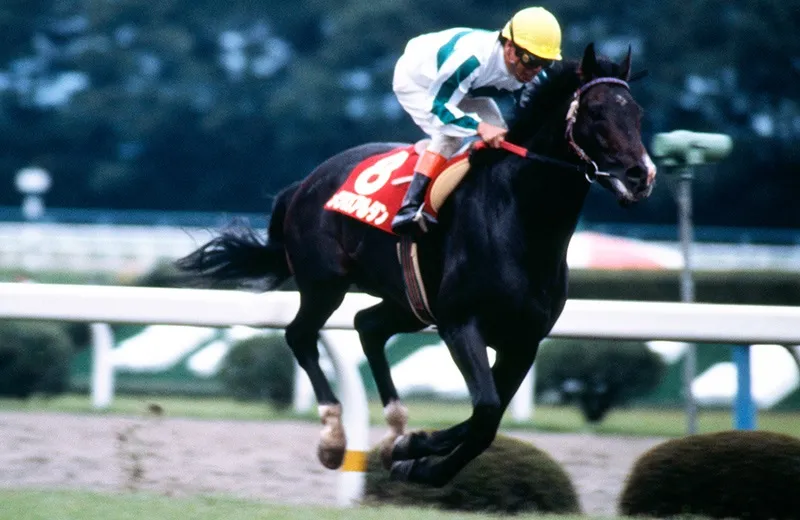
Three historical facts the character preserves almost exactly:
- The surviving twin. Ardan was born a twin; the other foal was stillborn. In racing lore, twins are considered cursed, 双子は大成しない, “twins never amount to anything.” So Ardan carried a double verdict handed down at birth: a dead sibling, and a superstition that twins fail. The game keeps the stillborn twin as canon backstory. It is not invention.
- The glass legs. The real horse inherited weak feet and a frail constitution, which delayed his debut all the way to March of his four-year-old year, extraordinarily late. The “glass legs” of the character are literal inherited conformation.
- The wrong-for-her debut. The real Ardan debuted on dirt, 1200m, a short dirt sprint, unsuited to his eventual mid-distance turf quality, and won it. The game turns this exact race into the thesis scene of the character (Part 3). The writers built her from the record.
And the record itself is the spine of everything: 14 starts, 4 wins, one G2 title (the 1989 Takamatsunomiya Hai), and a long row of placings in the biggest races, 2nd in the Japanese Derby, 2nd and 3rd in the Tenno Sho (Autumn), all run against the strongest generation in Japanese racing history: Oguri Cap, Tamamo Cross, Super Creek, Yaeno Muteki, Sakura Chiyono O. He was, in the words of his own JRA memorial page, 「脇役と呼ぶには惜しい」, too good to be called a supporting player. He died in 2002, seventeen years old.
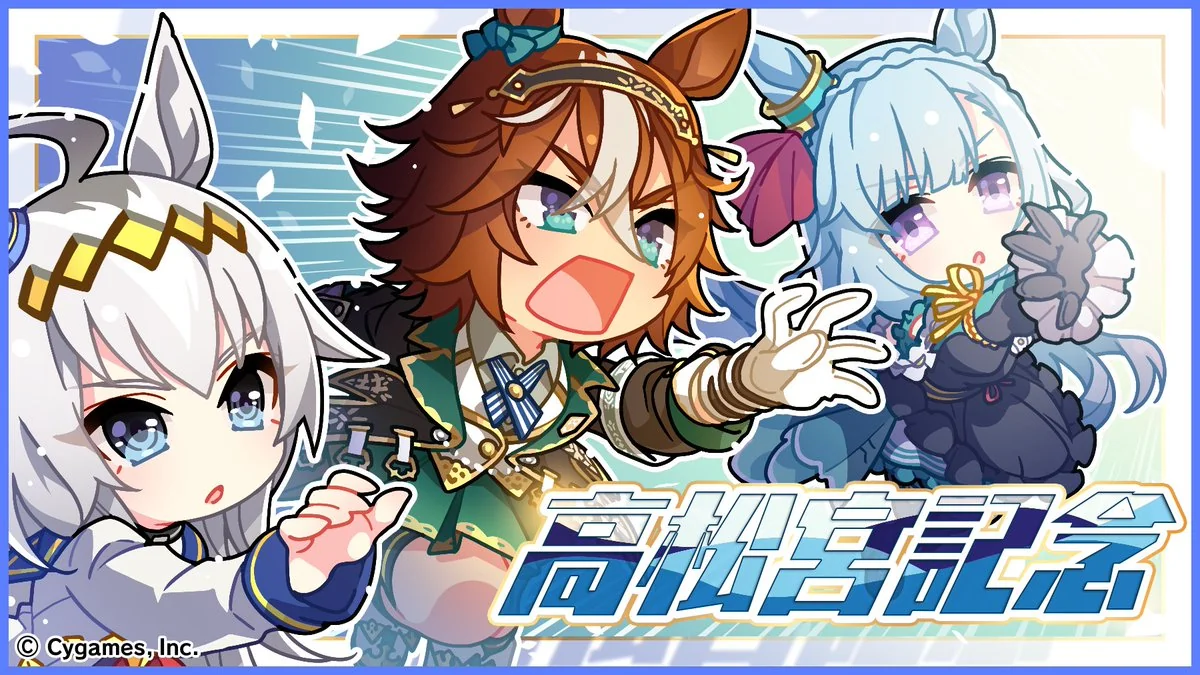
Read that record shape carefully, because it recurs in the character as philosophy: she has no “ran a decent fourth.” She wins or she places or she falls short, there is no comfortable middle result. A horse with no compromise gear becomes a character whose entire creed forbids the hedge.
Part 2Courage, Not Fearlessness
The distinction this whole character rests on, and the one most readings blur.
Fearlessness is the absence of fear, not perceiving the danger, and therefore not being brave, merely oblivious. Ardan is the opposite of oblivious. She knows precisely what she is risking, in clinical detail. The story opens with her being discharged from a hospital, with the staff spelling out the stakes: 「骨折や捻挫は、繰り返せばそれだけ脚の寿命を縮めます」, fractures and sprains, repeated, shorten the very lifespan of your legs. Her parents call in tears, begging her not to race. Her family doctor, a man who has known her since childhood, gives the trainer a prognosis grim enough that it becomes a turning point in the story. She is told, by strangers and specialists alike, that she is 「レースに出るべきではないウマ娘」, a horsegirl who shouldn’t race.
She perceives all of it. And she runs anyway. That is not fearlessness; it is courage in the precise sense, action taken because the cost is understood and chosen rather than in ignorance of it.
What makes it land harder is that she does not even argue with the verdict. When strangers say cruel things to her face, she agrees: 「全ては事実、ですので」, because it’s all true. No bitterness, no defensiveness, no self-pity. She accepts the diagnosis as accurate and then declines to let it decide her behavior. The trainer, watching this, repeatedly “loses his words and just stands there”, because there is no argument to win. She has already conceded every point and chosen anyway.
This is why her serenity is not the same as peace (Part 6), and why her courage is not the same as confidence. It is a decision made with full information, renewed every time she steps onto a track that might be her last.
Part 3Glass: The Motif and Its Hidden Property
Glass is to Ardan what a gemstone is to her sister, the organizing image, present in her chapter titles (硝子の彼女 “Girl of Glass,” ガラスの脚 “Glass Legs,” 凛々しき透明 “Valiant Transparency”), her trauma, and the climactic praise that vindicates her. But the motif works on two levels, and the second is the key.
The surface property: transparency
On the surface, glass means legible fragility. Where a gem hides its interior, glass hides nothing, you can see straight through to how breakable it is. Ardan’s frailty is public. Everyone can see the break coming; the pity is in every stranger’s eyes. Her chapter title 凛々しき透明, “valiant transparency,” names this directly: she is brave in a way that is completely visible, with nothing concealed. This is already a meaningful inversion of the hidden-depth kind of character. But it is not the deep reading.
The hidden property: glass does not yield
Here is the physical fact the writers build her philosophy on. Glass is an amorphous solid, structurally closer to a frozen liquid than to a crystal, with no give. Unlike metal, which bends before it breaks, or wood, which splinters and warns, glass stays perfectly rigid under increasing stress, absorbs nothing, deforms not at all, and then fails all at once, totally, with that sound. It either holds its exact shape or it shatters completely. There is no middle state. No bending to survive.
Now place her defining philosophy beside that fact:
「退くことを一度でも覚えてしまった脚は、勝負を決めるその一瞬においても、前進を躊躇う。」 "Legs that have once learned to retreat will hesitate to advance, even in the deciding instant."
She is describing the fracture behavior of glass and calling it a virtue. A thing that never yields, never bends to save itself, that holds the line absolutely or breaks absolutely, that is glass, and that is her entire philosophy of running. Her refusal to ever learn caution is not only emotional grit; it is a choice to be glass at the structural level: no ductile middle gear, hold or shatter, never deform to survive. This is the same fact as the real horse’s record (Part 1): no decent-fourth, no compromise result. Win, place, or fall, never a hedge. The material, the creed, and the record are one fact in three registers.
The completion: the motif inverts
The glass motif travels a full arc across the scenario, and the destination is the character’s vindication.
It begins as the thing that makes others wince, 「彼女の脚はガラスのように繊細だ。疾駆に憂いを抱いている者も少なくない」, her legs are delicate as glass; not a few people are anxious watching her run. The glass-breaking sound itself is her lifelong auditory trauma: 「ガラスの割れる音が、嫌いだった」, I hated the sound of breaking glass, the sound of her own body failing, returning in nightmares and in the panic mid-race when her legs scream.
At the Japanese Derby, the sound transforms. Racing all-out, past what her body should allow, she hears the shatter, and reinterprets it: 「私が“今”――限界を超えた音だ」, that was the sound of me, now, breaking past my limit. The same sound, recoded from destruction to transcendence. The thing that meant she was breaking now means she is breaking through.
And at the final Tenno Sho, the inversion completes from the mouth of the era’s monster. Oguri Cap watches Ardan run and names it:
「とてもカラフルな、ガラス細工のような輝きだった。」 "It was a very colorful, glasswork-like radiance."
The exact material she was pitied for, fragile, breakable glass, becomes the word the greatest runner of the generation reaches for to describe her beauty. Not radiant despite the fragility, but radiant as glasswork, which is precious precisely because it is delicate. The breakability is the source of the beauty, not a flaw to be excused. The motif has traveled from “everyone can see you’ll break” to “your breakability is the most beautiful thing on the track.”
Glass slippers
One scene literalizes the whole motif. In the “ガラスのワルツ” (Glass Waltz) story, Ardan plays Cinderella, dancing for hospitalized children in glass slippers: 「シンデレラは軽やかに踊った。優雅に微笑んだまま、いつ砕けるとも知れぬガラスの靴で」, Cinderella danced lightly, still smiling gracefully, in glass slippers that might shatter at any instant.

A shoe’s job is to flex with a moving foot; a glass shoe is a contradiction, footwear made of the one material that cannot bend with you, that shatters if you move wrong. Ardan’s legs are glass slippers: racing-legs made of the material that cannot take the impact of racing. And the fairy tale they cast her in is the one story built entirely around borrowed, time-limited radiance, beauty granted only until the clock runs out at midnight. Cinderella’s deadline is Ardan’s countdown. They handed her the single tale that is about dancing beautifully in glass that is destined to break, before the magic ends, and let her do it smiling.
Part 4“今” (Now): Presentism as Triage
The densest motif in her entire text is not glass, it is 今, “now,” almost always in pointed quotation marks, appearing dozens of times across every chapter. And it is essential to read why she lives in the now, because the warm surface reading (“live in the moment”) inverts the actual meaning.
She lives in the now because she cannot afford to believe in a future. Her body may end the story at any race, so banking on a long career, setting distant goals, planning ahead, these are luxuries her clock forbids. She says so plainly at her debut. When the trainer notes that a goal is supposed to look toward the future, she answers:
「故に、目前の一戦にのみ全てを賭ける。そうすることで、常に“今”の私をこの世界にひと筋残したいのです。」 “And so I stake everything on the one race before me. By doing that, I want to leave a single streak of ‘the me of now’ upon this world.”
This is glass-and-clock logic fully assembled. She cannot promise a career, so she refuses to count on one. Each race is treated as possibly the last because it might be. 「ひと筋残したい」, to leave one streak, is the same vocabulary as her 光跡 (light-trail) and 刹那 (instant) motifs: she is trying to etch a single visible mark now, because accumulation is not promised to her. Her presentism is not serenity. It is triage. A person who knows the building may collapse does not draw up ten-year plans; she does the one most important thing today.
Every core choice flows from this. The wrong-for-her dirt-sprint debut, refusing to wait months for a suitable race, is pure triage: 「ウマ娘が最も貴き舞台で輝ける時期には、限りがあります……これ以上デビューが遅れれば、宿願を果たす前に、私の全盛期は終わるでしょう」, the time a horsegirl can shine on the greatest stage is limited; if my debut is delayed further, my prime will end before I can fulfill my desire. Wait for the right conditions, and the future they require may never arrive. Pull back to protect the legs, and you trade a certain present for an uncertain future. Live for later, and there may be no later. The dirt sprint, the refusal to retreat, the living-in-now, all three are the same refusal: never sacrifice a real present for a future that isn’t promised.
The associated self-image is the brief, bright, soon-forgotten light. She takes the trainer to an exhibition of posthumous works (刹那展). She identifies with the forgotten ghost of an old castle, wishing she could 「忘れ去られてしまった誰かの輝きをほんの刹那でも甦らせる」, revive someone’s forgotten radiance, even for an instant. Her stated acceptance of her own likely fate: 「すぐに色褪せ、忘れ去られる。――それでも、『今』」, it will fade at once and be forgotten. Even so, now. The brevity is built into the goal. She is not trying to last. She is trying to blaze, once, visibly, before the glass gives.
Part 5The Wound and the Mask
Ardan’s frailty is the wound, but the more revealing detail is what she built on top of it: an elegance that is partly a kindness toward others, and partly a disguise.
The childhood is established in the career story and deepened in the support cards. Too frail to run, she spent her early life shut in the family manor (屋敷にこもりきり), watching other children play through windows, describing them exactly as one would describe an unreachable paradise: 「まるで光に包まれているよう」, as if wrapped in light; 「別の世界の光景」, a scene from another world. The “深窓の少女へ” card states the wound directly, in her own voice:
「どれだけ青空の下で駆けまわることを夢見ても……私の前にはいつだって、それを阻む見えない壁があった。伸ばした手に冷たい感触を感じながら……」 “However much I dreamed of running under the blue sky, there was always an invisible wall blocking me. Feeling the cold against my outstretched hand…”
And the resolution she draws from it, the creed she runs on, in four lines:
「だから……今、私は走る。かつて阻まれた景色の中で、いつかの涙が、無駄ではなかったと――証明するために。」 “So now, I run. Within the very scene I was once barred from, to prove that those long-ago tears were not in vain.”
The mask is subtler and is its own kind of courage. Ardan sits perfectly upright at all times, even after a meeting ends, 「彼女の背筋は伸ばされたまま」, her back stays straight. The reason traces to childhood: a sickly child learns that any sign of weakness, a slouch, a wince, makes the people around her worry, and she cannot bear being the cause of others’ worry. Her recurring anxiety throughout is 心配をかけないように, so as not to cause concern. So the flawless ojou-sama posture is not vanity. It is a performance of wellness mounted for the comfort of everyone watching, a fragile girl holding her body in a shape that says don’t worry about me, so the worry lands on her alone. Her elegance is fragility doing labor on behalf of others.
The narration names her duality outright in the “ガラスのワルツ” monologue: 思慮深さ (thoughtfulness) and 烈しさ (fierce intensity) are both her weakness and her charm, the serene, considerate surface and the burning will beneath are the same person, and the gap between them is where the rivals (Part 7) are drawn in.
Part 6The Sister
Ardan’s relationship to Mejiro Ramonu is canon, central, and woven through her own text, it is the condition she starts from and the relationship she eventually outgrows. (It belongs in this study for that reason; it appears here only as it lives in Ardan’s own material.)
The shadow is the starting condition, imposed from outside. Ardan is introduced to the world as 「メジロラモーヌの妹」, Ramonu’s sister, and measured against that record before she runs a step: 「逸話に事欠かない、偉大な姉の強すぎる光が、アルダンさんを余計に影へと追いやっている」, the too-strong light of her storied, great sister pushes Ardan further into shadow. This is not insecurity; it is the objective social fact she is handed. She names her goal precisely in her self-introduction: to be seen 「“メジロラモーヌの妹”ではなく、個として」, not as “Ramonu’s sister,” but as an individual, and chooses, deliberately, to run a different route than her sister did, to carve a separate name.
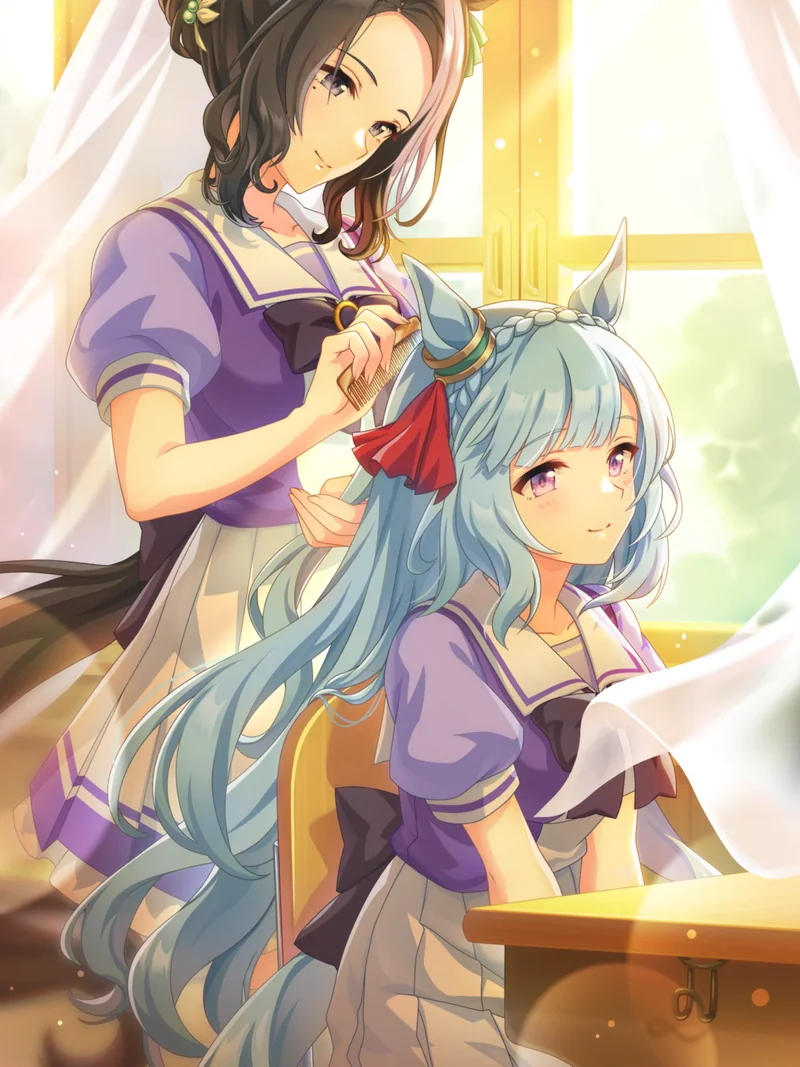
The shadow began as a lifeline, not a resentment. One childhood scene reframes everything. Young Ardan, too frail to run, watched the person who shared her exact diagnosis, the same weak Mejiro legs, overcome it and run. That person was Ramonu. 「眩しい――私だって……姉様のように……!」, so dazzling, I want to be like you, sister. The narration: 「その極光の萌芽に惹かれ、そして……縋った」, I was drawn to the budding of that brilliant light, and I clung to it. The word 縋った, clung, is the truth of the early relationship: Ramonu’s recovery was the proof-of-concept that Ardan’s own frail legs might also run. She did not resent the shadow. She reached for it as evidence that fragility could be beaten.
The shadow dissolves by being outshone, not defeated. At the Derby, and this holds across all three branch outcomes, whether she wins, loses narrowly, or is beaten by Sakura Chiyono O, the revelation is identical: 「姉様のことを……忘れていた」, I had forgotten about my sister. And the reframe: 「姉様の極光を忘れるほどに、彼女たちと全力で競えたからこそ」, precisely because I could compete with everything I had against them, enough to forget even my sister’s radiance. The shadow is not conquered by surpassing Ramonu. It evaporates the moment Ardan is so completely present in her own race, so fully absorbed in the rivals ahead of her, that the comparison stops existing. You can only stand in a shadow while you are looking sideways at the light; racing forces her to look dead ahead. By the second year, the announcers confirm it from outside: she has 「“メジロアルダン”としてその名を確立した」, established her name as Mejiro Ardan.
The relationship resolves as equals. In the “どうぞ、この手を” story, Ardan finally dances with Ramonu, and the staging inverts the childhood exactly. The girl who once watched from the sidelines, clinging to a light above her, now approaches and extends her hand as a peer. Ramonu, in her toying register: 「覚悟ができたから来たのでしょう。ならば――どうぞ、奪い取ってご覧なさいな」, you came because you’re resolved; then go on, try and take it from me. The narration: 「翻弄するメジロラモーヌ、食らいつくメジロアルダン」, Ramonu toying, Ardan biting back, two sisters dancing like a duel. And Ramonu’s closing line, the highest approval available: 「貴方の熱……いい頃合いね。今度はターフで――踊りましょう」, your heat, it’s just right now. Next time, let’s dance on the turf. The treasure invites the once-fragile sister to race her as a worthy rival. From clinging to the light, to standing level with it.

Part 7The Rivals Who Replaced the Shadow
If the sister was the first light she ran toward, Sakura Chiyono O and Yaeno Muteki, her real historical Derby-generation rivals, are the light she runs beside: the present-tense reason to run that has nothing to do with proving anything to anyone. Her own card-poem names them by their essences: 「かたや武辺の中に光明を得る者。かたや薄紅の淡き憧憬を抱く者。まだ遠き背中たちに、焦がれるばかりだ」, one who finds her light within martial valor (Yaeno), one who holds a faint pale-pink yearning (Chiyono O, cherry-blossom); I do nothing but burn with longing for those still-distant backs.
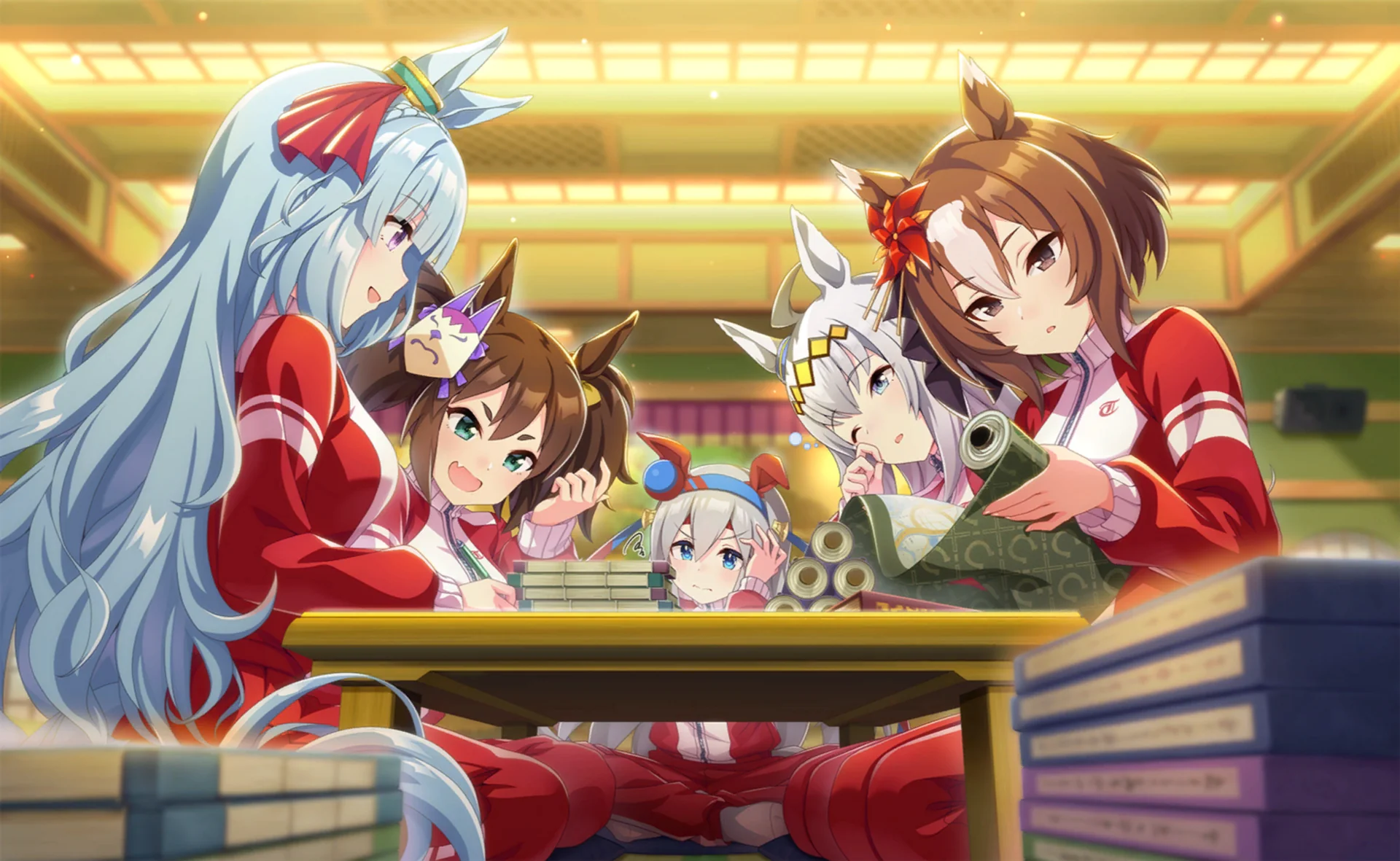
The rivals give her the childhood the illness stole. In the “見たかった情景” story, the four of them, Ardan, Chiyono O, Yaeno, Super Creek, talk about childhood games, and Ardan admits she has none: 「体のこともあり、昔は屋敷にこもりきりで……みなさんがなさっていたような遊びは、あまり経験がなく」, because of my body, I was shut in the manor; I don’t have experience with the games you all played. Super Creek’s response is to build the missing childhood on the spot, 「いまから私たちで思い出を作るのってどうでしょう?」, why don’t we make those memories now? They play the pretend-games she missed; they hunt four-leaf clovers and quietly let her find one; she preserves it in resin, 「今日の記念として。大切に」, as a memento of today, treasured. Where the sister relationship was vertical, looking up at a light, the rivalries are horizontal, shoulder to shoulder. That is the upgrade that lets the shadow stay gone.
Her care language and her rivalry are the same act. The “みんなで作る特製ドリンク♪” story shows how she loves: she has bought a siege-quantity of ingredients because she has been secretly health-managing her rivals’ exact weaknesses, cocoa and komatsuna for Chiyono O’s iron (she can’t eat liver), Greek yogurt for the bones Yaeno secretly wants to strengthen. When the read is offered two ways, that’s how much you love them, or you’ve been scouting your rivals, she affirms both: 「そういう意味もあるかもしれませんね♪」. For Ardan, studying a rival and cherishing a rival are one motion. She learned care from years as the patient (the long relationship with her nurse-maid, ばあや), and she now aims that caretaking at the very people she is trying to beat. Her rivalry is a form of tenderness; her tenderness is a form of reconnaissance.
Her standard pulls the rivals upward. In “立ちたい場所はただ1つ,” Chiyono O admits she avoids practicing the demanding center position out of fear she’ll fail. Ardan, who deliberately took center, answers: 「私はただ、最高に輝ける瞬間を追い求めたいんです。たとえ1度きりの輝きだったとしても……その時が来たら絶対に逃したくない」, I just want to chase the moment I can shine brightest; even if it’s a one-time radiance, when it comes I never want to let it slip. And it works on Chiyono O, 「私も……勝ちたいですっ!」, I want to win too! The girl once lifted by watching someone stronger has become the light that lifts others.
This is why the Chiyono O crisis is the scenario’s emotional peak. In the career story Chiyono O breaks down, injured, watching everyone grow stronger, repeating that she is being left behind, nearly retiring. And Ardan is the one who reaches a hand back, because she is the person who knows most precisely what it is to be the one left behind while others run. The role inverts completely: the girl Chiyono O once nursed through hospital stays now nurses Chiyono O through the crisis of feeling left behind, and Chiyono O returns to racing. Ardan pays back not a debt but a form, the exact faith once given to her, given now to the friend who first gave it. The theme of the entire character lives in that reversal: being lifted and lifting others are the same motion, and the fragile are the ones best equipped to catch the falling, because they know the ground.
The arc of her reasons to run: escape the shadow → forget the shadow (the Derby) → run toward the rivals for their own sake, to make 「歴史に残るレース」, a race that stays in history, with them. Courage was always the constant. What changed was what the courage was for.
Part 8The Trainer, and the Future She Could Not Hold
Here the clock she lives by meets someone willing to keep time for her, and the structure is the most elegant thing in the character. If Ardan cannot afford to believe in a future (Part 4), then the one thing she fundamentally lacks is a tomorrow, and the trainer’s whole role, his form of devotion, is to hold that tomorrow for her.
The vow. On a high overlook, Ardan tries to push the trainer away. She confirms the doctor’s prognosis is true, calls herself 「空疎なガラス細工の如きウマ娘」, a hollow, glasswork-like horsegirl, and asks point-blank: 「壊すかもしれない覚悟は、お有りですか?」, Are you prepared to be the one who might break me? The narration notes this test is itself her gentleness, giving him a clean, guilt-free exit. His answer is not reassurance. It is a tablet: output rotations and training menus with 「いくつかパターンが」, several branching patterns, each built around a different possible future condition of her failing body, 「メジロアルダンの今後の様々な状態を想定し、自分が考えうる限りのパターンを全てまとめたもの」. And the line that defines the relationship:
「そして、“今”に生き、“今”のみを見つめる彼女のために――俺が、君の“未来”を描く。」 "And so, for her who lives in 'now' and looks only at 'now', I will draw your future."
The verb 描く, to draw/paint, is deliberate. He becomes the one who paints the future Ardan dares not paint for herself, not protecting her from the risk, but making the risk survivable to keep choosing, by being the one who plans past it so she is free to spend everything on today.
The proof it works. Later, she does something she has never done: she speaks of a goal that is 「少し、先の話」, a little ways ahead, and catches herself, startled: 「いつも“今”か“今”かと言っていたのに」, I always said now, now, and yet… For a character whose entire creed is presentism-as-triage, voluntarily speaking in the future tense is seismic. The trainer feels the weight of it: he is 「どこか嬉しく」, somehow glad, that she turned her eyes a little toward the future and put it into words. He gave her a tomorrow to stand on, and she took one careful step onto it.
The true ending, she steals eternity back, and makes it mutual. The payoff (“此処に誓うは”) is the most precise philosophical inversion in the character. The trainer offers to resolve her mortality the conventional way: your light-trail outlives you, you are remembered, 「君は俺にとって、“永遠”の輝きだ」, you are, to me, an eternal radiance. And Ardan refuses it:
「それでは、不公平です。だって、それでは私だけが永遠になってしまうじゃないですか……!そんなのは、嫌です。」 "That's unfair. Because that way, only I become eternal. I don't want that."
The girl who could never believe in a future is handed the ultimate future, immortality through memory, and rejects it for being one-sided. She does not want an eternity she merely receives. She wants one she participates in. So she inverts the entire structure:
「トレーナーさんの“今”と“未来”は、私が刻みます。トレーナーさんが私に、そうしてくれたように――この命ある限り、貴方の“未来”を刻み続けます。」 “I will inscribe your ‘now’ and your ‘future.’ Just as you did for me, for as long as this life lasts, I will keep inscribing your future.” 「貴方にとっての永遠である私が、貴方の“今”と“未来”を刻み続ければ……私たちだけの“永遠”になりますから。」 “If I, your eternity, keep inscribing your now and your future, then it becomes an eternity that belongs only to us.”
The trainer held her future because she could not. Now she chooses to hold his, not because he cannot, but because that is how she converts a received immortality into a shared one. The whole movement of the character resolves here: a girl who lived only in NOW, who could not afford a future, who etched single instants because she dared not count on accumulation, ends by deliberately choosing to inscribe a future, his and hers, together, and naming it 「私たちだけの“永遠”」, an eternity that is only ours. She does not defeat her mortality by being remembered. She defeats it by becoming the one who does the remembering, mutually, so that neither of them stands alone on either side of the light. And she paints him, the family’s painting motif closing on her own terms: not to archive a love she already had, but to create the future she never let herself believe in.
Part 9The Through-Line (Synthesis)
Line the parts up like panes, and the light goes straight through.
Mejiro Ardan was born with glass legs and a death-sentence verdict handed down before she could stand, a dead twin, a cursed-twin superstition, a body that physically cannot do the one thing she wants. She looked at that verdict clearly, conceded every factual point of it, and chose to race anyway: not in ignorance of the cost (that would be fearlessness) but in full knowledge of it (which is courage).
On top of that choice she built a philosophy that is, at the structural level, the behavior of glass, a thing with no give, that holds its shape absolutely or shatters absolutely and never bends to save itself. 「Legs that learn to retreat will hesitate in the deciding instant.」 No compromise gear, in her creed or in the real horse’s record. Because her body is a clock, she lives entirely in “now”, not as serene mindfulness but as triage, refusing to sacrifice a certain present for a future that may never arrive, trying to etch a single visible streak of light before the glass gives.
Her relationships map the arc of her reasons to run. The sister was the lifeline she clung to and then outgrew, the shadow that dissolved not by being beaten but by being outshone, the moment rivalry made her look dead ahead instead of sideways. The rivals became the light she runs beside: peers who gave her the childhood the illness stole, whose weaknesses she tends as both love and reconnaissance, whose courage she raises by example, and one of whom she catches when she falls, repaying the exact faith she was once given. The trainer held the one thing she could not afford to hold, a tomorrow, until, at the end, she chose to pick the future up herself and make it mutual.
The glass that everyone watched, waiting for it to break, is the same glass the era’s monster finally called 「カラフルな、ガラス細工のような輝き」, a colorful, glasswork-like radiance, beautiful because breakable. That is the whole character: a fragile thing told at birth it would amount to nothing, deciding, race after race, to throw one more streak of light across the sky before the glass gives, and discovering, at the very end, that light thrown with someone does not have to fade.
「短くとも。儚くとも。ほんのかすかな光跡であろうとも。」 "Even if it is short. Even if it is fleeting. Even if it is only the faintest trail of light."
Appendix, Lines Worth Keeping
The lines that leave a trail of light, with sources. Branch-dependent material is flagged.
| Line (JP) | Translation | Source |
|---|---|---|
| 退くことを覚えた脚は、勝負を決めるその一瞬においても、前進を躊躇う | Legs that learn to retreat will hesitate even in the deciding instant | Intro / debut |
| ウマ娘が最も貴き舞台で輝ける時期には、限りがあります | The time a horsegirl can shine on the greatest stage is limited | Intro (dirt-sprint debut choice) |
| 全ては事実、ですので | Because it’s all true | Intro (to strangers’ cruelty) |
| だから……今、私は走る……いつかの涙が、無駄ではなかったと証明するために | So now I run, to prove those long-ago tears were not in vain | Support card「深窓の少女へ」intro poem |
| 常に“今”の私をこの世界にひと筋残したい | I want always to leave one streak of “the me of now” on this world | Career, debut |
| すぐに色褪せ、忘れ去られる。――それでも、『今』 | It will fade at once and be forgotten. Even so, now | Career / home lines |
| 忘れ去られてしまった誰かの輝きを、ほんの刹那でも甦らせる | To revive someone’s forgotten radiance, even for an instant | Intro (the castle ghost) |
| 壊すかもしれない覚悟は、お有りですか | Are you prepared to be the one who might break me? | Career, the vow |
| 俺が、君の“未来”を描く | I will draw your future | Career, the vow |
| いつも“今”か“今”かと言っていたのに | I always said now, now, and yet… | Career, first future-tense |
| とてもカラフルな、ガラス細工のような輝きだった | A very colorful, glasswork-like radiance | Career, final Tenno Sho (Oguri) |
| それでは、不公平です。私だけが永遠になってしまう | That’s unfair, that way only I become eternal | Career, true ending |
| 私たちだけの“永遠”になりますから | It becomes an eternity that is only ours | Career, true ending |
| 今度はターフで――踊りましょう | Next time, let’s dance on the turf | Support card「どうぞ、この手を」(sister) |
| シンデレラは……いつ砕けるとも知れぬガラスの靴で | Cinderella, in glass slippers that might shatter at any instant | Support card「ガラスのワルツ」 |
Translations are working renderings aimed at preserving meaning and register; the Japanese is the authority.
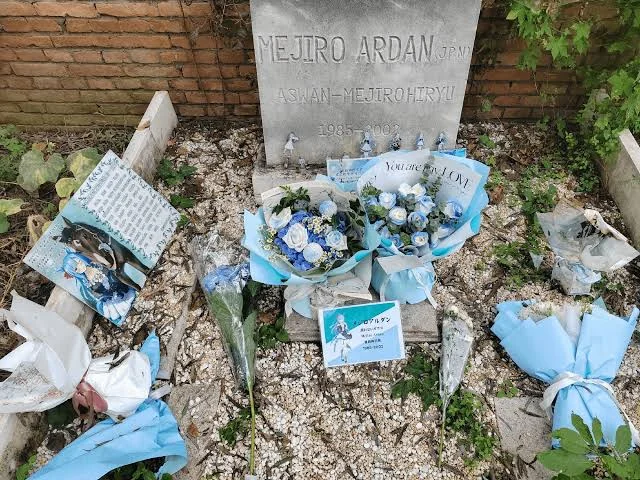
The character ends by refusing an eternity she only receives, and choosing one she inscribes. The real horse got the other kind anyway. He died in 2002, seventeen years old, after a career of near-misses. Decades on, someone still visits.