Thesis
Her owner took his own name off her.
The colt was by Dancing Brave out of Goodbye Halo, eleven top-level victories between the two parents, and Yoshio Asakawa dropped his stable prefix from the registration so the animal would carry only a title and a charge: become the best of the Halo line. Before the horse could stand, it had been handed a destiny instead of an identity.
The game keeps that structure and moves it indoors, from an owner to a mother. And the reading everyone reaches for from there is the obvious one: a proud girl with a famous parent, loud because she is spoiled, chasing a win to prove herself. That reading is not wrong so much as it is looking at the wall and calling it the house. The loudness is not pride. It is masonry, laid daily, against one sentence.
Pull the wall down, and this is the sentence it was built against:
King Halo was handed a verdict by the one person qualified to deliver it, her mother, a legend who had been absent for her whole childhood and who told her she had no talent and should give up. The King persona is a rehearsed, effortful construction built to keep that sentence from reaching her. Because it was built against her mother, it is made of exactly her mother’s materials, which is why her defiance keeps curdling into imitation. And because the acknowledgment she was running for was never available at any price, no race result could have ended the chase. What ends it is not a victory. It is a witness.
The parts below take the long way round, the way she did: why the laugh has to be practised, why she forbade the one person who could help her from naming her actual talent, why the branch structure of her career story is the argument rather than the backdrop, and why the story refuses her a reconciliation scene and is better for refusing it.
Part 1The Real Horse
King Halo (キングヘイロー, 1995–2019) was foaled on 28 April, a date the game gives the character unchanged. He was by Dancing Brave, winner of the 2000 Guineas, the Eclipse, the King George and an Arc still voted among the greatest performances ever run, out of Goodbye Halo, a seven-time Grade 1 winner in America whose sire, Halo, also sired Sunday Silence. Four championships on one side, seven on the other. The Japanese press called him the eleven-crown baby (11冠ベビー) before he had done anything at all.
His record: 27 starts, 6 wins, 4 seconds, 4 thirds. One Grade 1.
The shape of that record is the character. Second in the Satsuki Sho by half a length. Second in the Mile Championship. Third in the Sprinters Stakes, third in the Yasuda Kinen. He was permanently in the frame and almost never the answer, and he was foaled into the 1995 generation, the one Japanese racing still calls golden: Special Week, Seiun Sky, El Condor Pasa, Grass Wonder. Against Seiun Sky specifically he went winless across both their careers. Not once, ever.
Two failures did the shaping.
- The Derby. In the 1998 Tokyo Yushun, the race every classic-bred colt is measured by, the eleven-crown baby went forward into one of the fastest paces in the race’s history, lost his composure, and emptied out in the straight. He finished fourteenth. Special Week won. The horse born to be a monarch ran his most public humiliation in the one race that would have proved the pedigree.
- The search. His connections could not work out where he belonged. He was entered at 1200 metres and he was entered at 3000, sprint to marathon inside a single career. That is not a campaign plan. It is an identity crisis conducted in public, in form lines, for years.
Then, at five, on his eleventh attempt at a Grade 1, he won the 2000 Takamatsunomiya Kinen over 1200 metres. A sprint. The horse bred to rule the classics took his only championship in the discipline his pedigree least predicted. He did not win where he was assigned. He won where he actually was, once somebody finally looked.
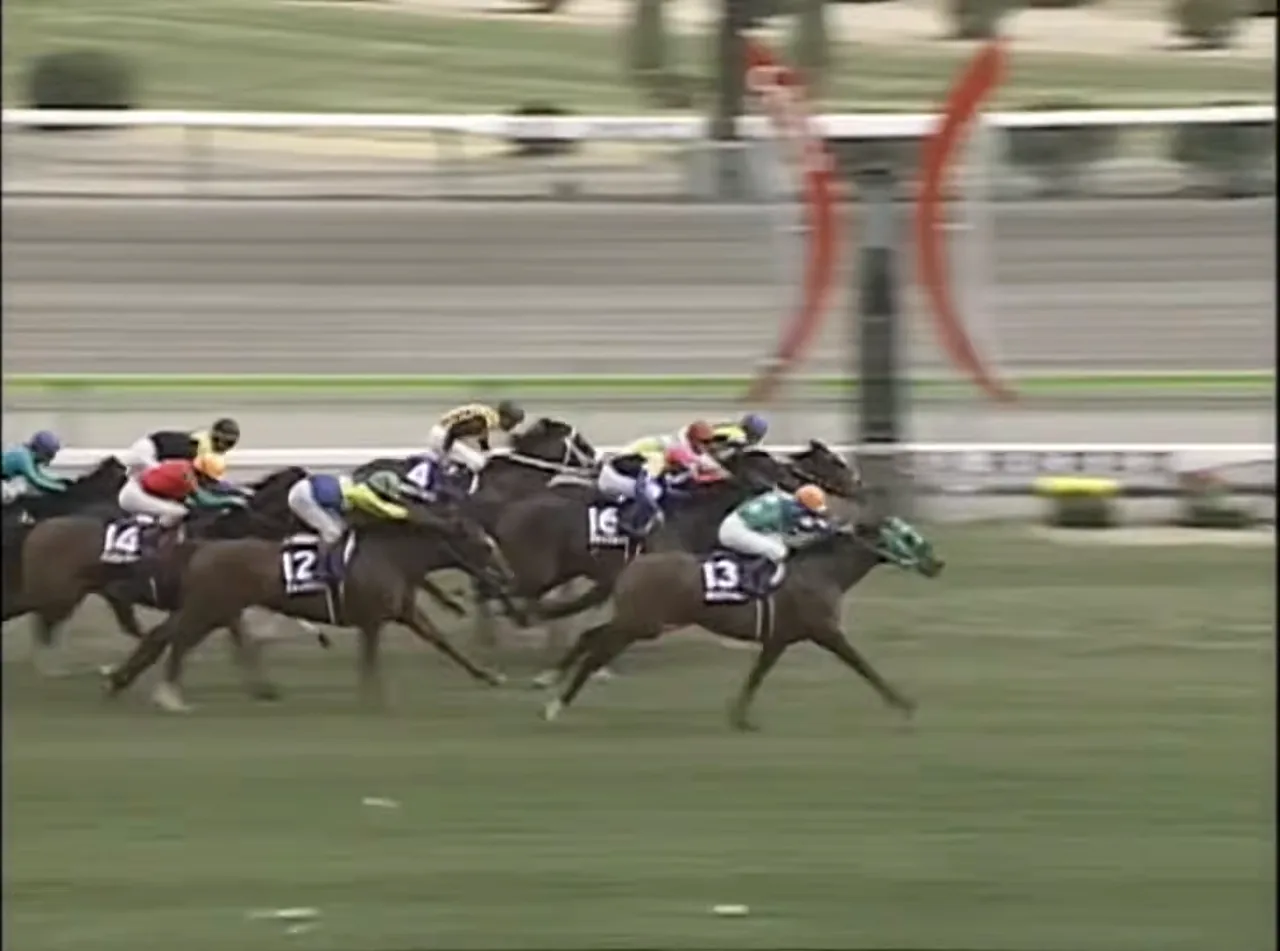
The game preserves this with unusual fidelity: the in-game condition for unlocking his signature victory requires the player to have entered at least five prior Grade 1 races and won none of them. The failure is coded as a prerequisite. There is no route to his triumph except through his defeats.
The coda belongs to Yuichi Fukunaga, and it is worth stating accurately because the sentimental version circulates widely and is wrong. Fukunaga was himself the son of a decorated jockey and came into the sport already measured against a parent. He was King Halo’s main rider through the classic campaign, and King Halo gave him the first graded win of his career in the 1997 Tokyo Sports Hai. He did not ride the Takamatsunomiya winner; Yoshitomi Shibata did. Fukunaga was in that race aboard Divine Light and finished second by a nose, beaten by the horse that had made him. He has called it the most regrettable result of his life, the single outcome he least wanted to see in front of him. His own first Grade 1 came two years later, in 2002, on Peace of World. King Halo died on 19 March 2019, aged twenty-four, five days before that year’s Takamatsunomiya Kinen. Fukunaga won that race, on another horse, and said afterward that he had felt King Halo pushing at his back.
The bloodline settled the argument the racecourse never did. He stood cheaply on the strength of one championship and became an excellent broodmare sire. His daughter Kawakami Princess won a Grade 1. Laurel Guerreiro won the Takamatsunomiya Kinen nine years after him. He is the damsire of Equinox, the highest-rated racehorse in the world in 2023. The pedigree was real the entire time. It simply paid out a generation late, into other names.
The JRA’s own tribute advertising ran with the image of the green-hooded horse who kept losing and never lowered his head. Hold that phrase. The game builds a person out of it.
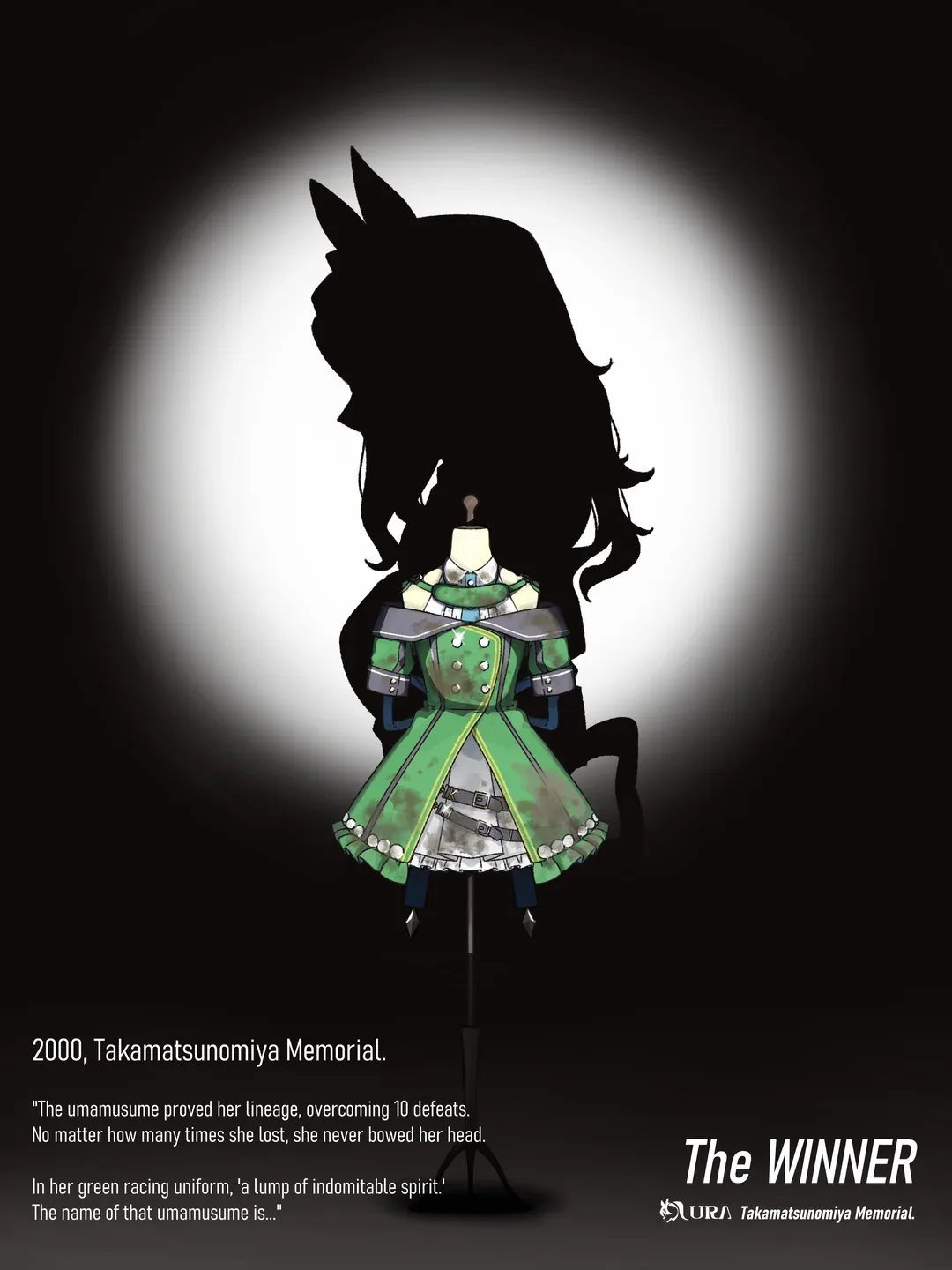
Part 2The Verdict (The Sentence Behind the Wall)
Her self-introduction is a wall of noise:
「おーっほっほ!私の名前はキングヘイロー。一流のウマ娘として最高の結果を残すわ!……この私の才能を世界中に示すためにもね!」 “Ohohoho! I am King Halo. As a first-class umamusume I will leave nothing but the finest results. If only to show this talent of mine to the whole world.”
一流, first-class, is the most repeated word in her entire corpus. She applies it to her diet, her posture, her grades, her tail, her laugh. Her profile is a catalogue of a person insisting on a category: asked her weight she refuses the number and answers “perfect,” asked about her ears she says they do not listen to anything that is not first-class.
Read that as vanity and the character vanishes. Read it as load-bearing and everything stands up. Here is what it is holding back:
「『あなたに走りの才能は無い。諦めなさい』『ほかの道のほうが幸せになれる』ですって。」 “‘You have no talent for running. Give up.’ ‘You would be happier on some other path,’ she says.”
And the childhood beneath it:
「現役中も、引退して仕事を始めてからも、私のことはほったらかしだったくせに。」 “While she was racing, and after she retired and started working, she left me to fend for myself.”
Absence, and then a ruling. Not worry in any register a child could receive as worry. A verdict handed down by the one person in the world whose verdict on this subject carries evidentiary weight, because she had actually done it, at the highest level, and could presumably tell.
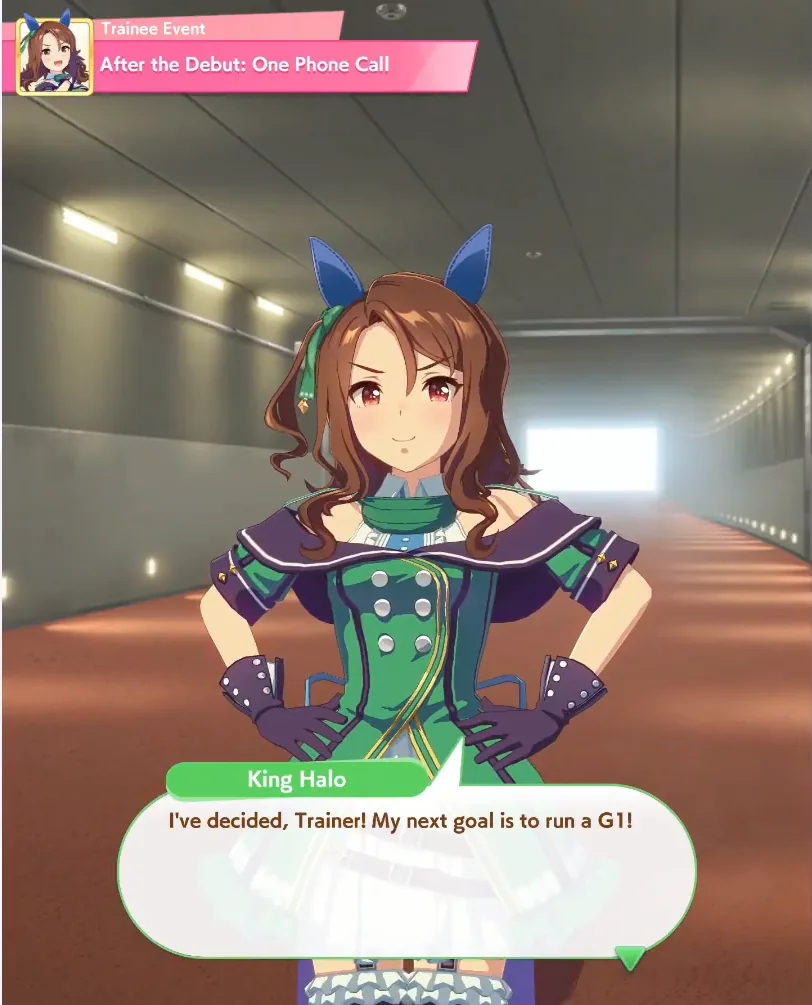
The career story escalates it toward prophecy. After the debut, the phone rings:
「『実力者ぞろいの世代で潰されるに違いない』『恥をかく前に帰ってきなさい』『才能がないと絶望してからじゃ遅いのよ』」 “‘You will be crushed in a generation full of real talent.’ ‘Come home before you embarrass yourself.’ ‘It will be too late once you despair at having none.’”
She hangs up, declares she will aim for the top and make her mother eat every word, and then the narration does something that settles the entire reading of the character so it never has to be argued for again:
「私に才能がないわけ……ないんだから。」自信を語る言葉とは対照的に、彼女の瞳は揺れていた。 “‘There is no way I have no talent.’ But against her confident words, her eyes were wavering.
She does not believe herself, and the text says so directly. This is not inference. It is the game handing over the key in the first act. Everything loud about her is a girl outrunning a suspicion, and the suspicion is that her mother was right, and her mother would know.
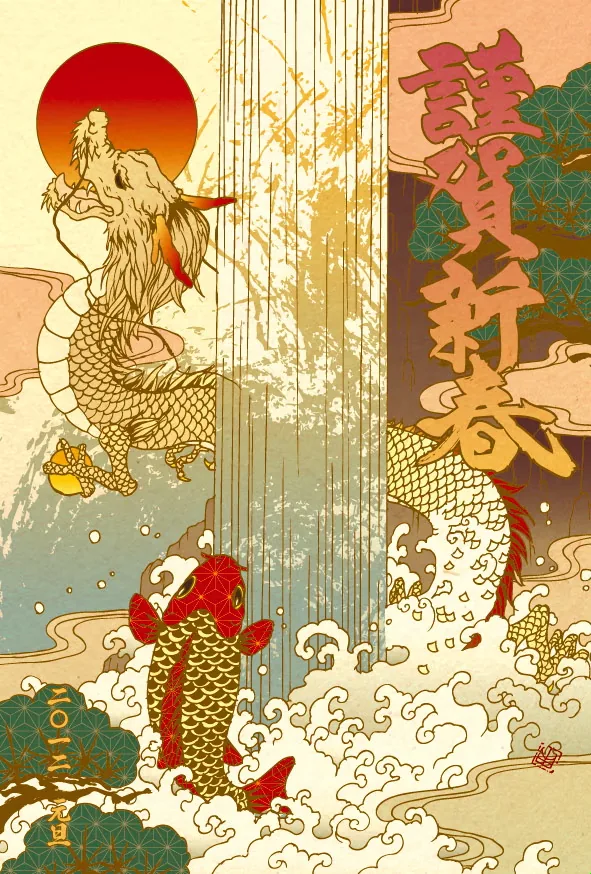
Two details in the profile give the fear its shape. The first is her phone wallpaper, which she refuses to show anyone: a candid photograph with her friends. The thing she actually guards is not her image. It is company. The second is what she names as her proudest possession, and it predates racing entirely: a drawing she made in elementary school of a carp climbing a waterfall, which won a school commendation.
The image is from the legend of the Dragon Gate, where a carp that fights its way up the falls becomes a dragon. Her proudest thing is a child’s picture of ascension through struggle, and what she is proud of is that somebody looked at it and said it was good. Not I was born great. I climbed, and someone noticed.
She left home essentially as a runaway, 家出同然, to race against her mother’s wishes. The road back is closed. The only direction available is forward, into a proof she has not yet earned.
Part 3The Construction
The persona is not a temperament. It is labour, and the game is unusually specific about the hours.
There is a random event in which she practises her laugh. Not laughs: practises, drilling the おーっほっほ over and over until her voice gives out, refining what she calls 一流の高笑い, the first-class laugh. And there is a chapter in which she asks the trainer to shift the day’s training start time so she can rehearse once more, because of a stumble in the previous Winning Live. He did not notice it. She tells him so herself, and then keeps going anyway:
「けどいかに人に気づかれなかったとしても、失敗は失敗よ。また同じ失敗をするようじゃ、私は私が許せないわ。」 “But however unnoticed it went, a failure is a failure. If I went and made the same mistake twice, I could not forgive myself.”
「――だって、私は一流のウマ娘なんだもの。」 “Because I am a first-class umamusume, after all.”
The standard is internal and merciless, and it is not really about excellence. It follows from a belief she states early: a trainer will have many runners across a career, but a runner gets one career. One attempt. If there is exactly one chance to disprove the verdict, no failure is survivable, including a failure with no witnesses.
The name is a claim, not a fact, and she knows it. Watch the verb in her own definition of the persona:
「何度泥を被っても嘲笑われても、私は"一流のキングヘイロー"を名乗り続けるわ。キングは後退しない。決して首を下げない。」 "However much mud I am dragged through, however they laugh, I will keep calling myself first-class King Halo. King does not back down. King never lowers her head."
名乗り続ける. To keep declaring the name. Not to be it. At some level she will not look at directly, she understands that the title is under permanent dispute and that the claiming is the job. Note also where 決して首を下げない comes from: the real horse’s JRA tribute used the same image, and a magazine photographer in an outfit story describes her running form as 首を下げずに胸を張る, head up and chest out. Her posture and her philosophy are the same sentence. She is holding a position in both senses.
The vanity is the same wall in a different room. In one event she notices her skin looks dull and a friend offers a filter app:
「アプリに頼らずとも自然な美しさを! 輝きを保ってこそ、キングだわ!!」 “Natural beauty, without leaning on an app. Keeping the shine is what makes me King.”
She would sooner overhaul her whole diet than accept a cosmetic patch. It reads as conceit. It is the same terror as the unseen dance turn: she cannot tolerate being apparently first-class, because the nightmare is that the title is counterfeit and someone will notice.
And the fear has a tell, in a phrase she uses to rally after a loss:
「なぜならば、私には翼があるから。生まれ持った才能という翼が!」 “Because I have wings. The wings of talent I was born with!”
Watch the tense and the source. Not I will build talent. The wings are already there, innate, inherited, and only the flapping needs work. She requires the gift to be congenital, because if talent is only ever earned then her mother’s verdict was accurate on the day it was delivered. This is the least flattering thing in her and it should not be smoothed over: she despises being called 親の七光り, a child coasting on a parent’s glow, and she still needs the pedigree argument to be true, because it is the only thing standing between her and the possibility that at ten years old she genuinely had nothing.
The armour holds in public and it charges rent in private. She gets recurring headaches and hides them from the juniors who trail after her:
「あの子たちには内緒にしてて。変に気を使われるのはイヤなの。」 “Keep it from them. I hate being fussed over.”
She will let exactly one person see the crack. That is the relationship the whole story turns on.
Part 4The Mirror
The chapter that makes this a study rather than a sympathy piece is the one about her mother’s work.
Her mother, after racing, became a celebrated designer of racing dresses. King Halo, who refers to her as あの人, that person, and who has spent every prior chapter spitting about her, says this:
「悔しいけど、あの人は一流よ。」 “It galls me, but that person is first-class.”
She reveres the craft. She uses her own signature word for it. And then:
「……私には服なんて、一切作ってくれなかったけど。」 “Though she never made me a single thing to wear.”
Her mother designs dresses for the sake of every umamusume who races. She never made one for her own daughter.
The obvious move here is to close the case on the woman. The game refuses to let you, and it refuses using the daughter’s own mouth. King Halo immediately supplies the defence: her mother has the design sense but is hopeless with her hands, too clumsy to sew, and being proud and vain would not have wanted her own daughter to see a botched attempt. Then she offers the birthday memory. Her mother would serve her a shop-bought cake, perfectly composed, and secretly eat the failed homemade one herself, alone, where nobody could see it.
And then she delivers her verdict on the cake, which is the most important thing she says in the chapter and the thing she does not hear herself saying:
「ばっかみたいよね。意地を張らずに失敗したって言えばいいだけなのに。」 “Ridiculous, isn’t it. She could just drop the stubbornness and say she failed.”
Hold that sentence. The whole story ends on her finally doing exactly this, in public, on camera, and it is the measure of how far she travels.
The trainer says the obvious thing. She is just like you.
「似てないわよ!」 "We are NOT alike!"
Three syllables, and the tragedy is fully assembled.
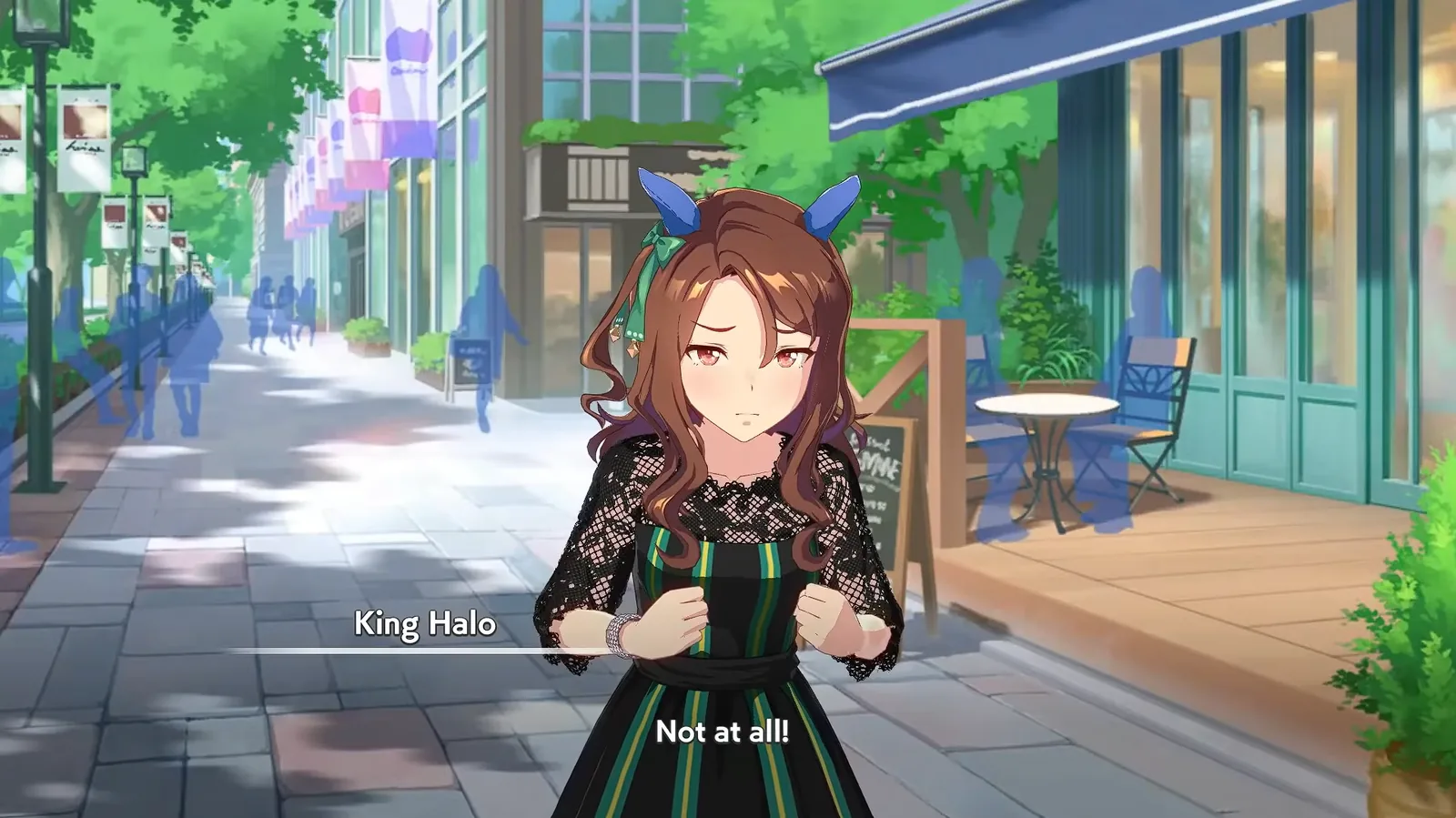
Look at what has actually been described. A woman who is proud, competitive and clumsy. Who cannot bear to be witnessed failing. Who hides the botched version and presents the polished one. Who expresses love through work and achievement because she has no warm register available.
That is a description of the daughter, line for line. The mother hid the failed cake out of pride; the daughter re-drills the unseen stumble out of pride. The mother could not make her a dress because she could not stand to be seen being bad at it; the daughter hides her headaches from the juniors who love her. They have the same architecture, and the architecture is precisely why they cannot reach each other. Two people in identical armour, each unable to be the first to take it off.
This is where a study can fail in either direction, and both failures are worth naming.
The first is making the mother a villain. The text works actively against it. It gives her the secret cake. It gives her a professional standard the daughter genuinely admires. It has the trainer ask whether she might simply have been worried, and then declines to answer him. Her verdict reads as contempt and reads equally as a frightened woman who knows exactly what it costs to live under a famous name, trying clumsily to spare her child a lifetime of being measured against her.
The second failure is the overcorrection: turning her into a misunderstood saint whose harshness was secretly kindness. That is just as false. Whatever she intended, a child was left alone for years and then told she was talentless by the one voice that could settle the question, and that child built an entire personality out of scar tissue. Intent does not retroactively unmake damage.
The honest position, and the one the text holds to the end, is that both are true at once: a woman who loved her daughter, damaged her, and could not say either thing aloud.
The inheritance runs deeper than pride, and King Halo demonstrates it without noticing. In one random event she is a wreck, skipping meals, distracted, buying a hole punch instead of dessert. Asked what is wrong:
「ただ、風邪で休んだ後輩たちをどう叱ってあげようか考えてただけ。」 “I was only working out how to scold the juniors who came down sick.”
She is sick with worry for them, and she can only frame it as figuring out how to tell them off. That is her mother’s method running in the caregiving direction, inside a girl who insists she is nothing like her mother. She did not merely inherit the pride and the hiding. She inherited the specific mistranslation, in which care comes out as criticism because tenderness has no available channel. The mirror the game holds up in 似てないわよ goes all the way down.
Part 5The Race That Has No Win Branch
Early in the career story, Air Groove, herself the daughter of a legend and herself someone who entered this sport inside a shadow, breaks up a press pack around King Halo and asks one question:
「『認められるためだけに走る』のか?……在るべき姿を今一度、考え直せ。」 “Do you run only to be acknowledged? Reconsider what you are supposed to be.”
King Halo has no answer. The text says it lodges in her chest. That question is the spine of everything after, and the story answers it not with a speech but with structure.
The Japanese Derby branches, and the branches converge.
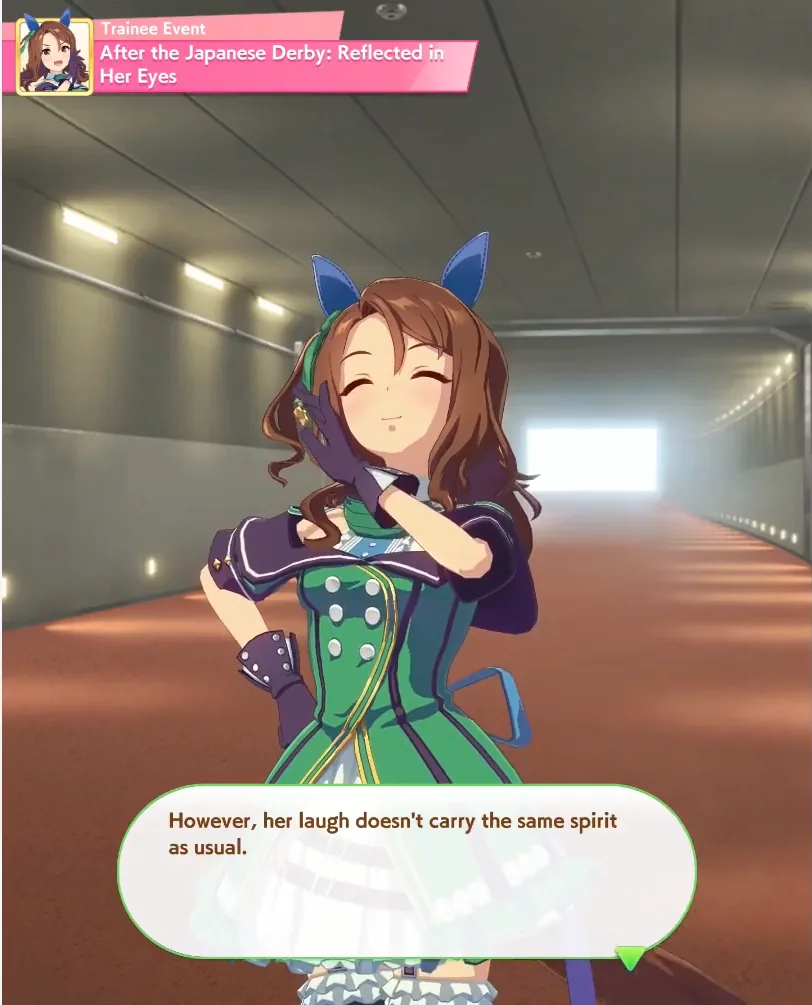
On the winning path she takes the biggest race there is. She glances across the celebration and sees Special Week in tears, apologising to her own mother for a result she is upset about. Then her phone rings:
「すごかったわね――スペシャルウィークさん。あんなに人を惹きつける走りを見たのは久々よ」 “She was magnificent. Special Week, I mean. It has been years since I saw a run that pulled people in like that.”
King Halo, quietly, points out that she was the one who won:
「せっかく運よく勝てたのだから、メッキがはがれる前に引き返した方がいいわ」 “Since you managed to win on luck, you would do well to turn back before the plating flakes off.”
The narration notes that her grand laugh comes out weaker than usual.
On the losing path the call connects by accident and the script is nearly identical. Special Week was magnificent. Did a feeling of giving up not well up in you. Come home before you disgrace yourself.
Lay the two calls over each other. The player can change the race. The player cannot change the phone call. Win the Derby and it was luck and the gold is peeling; lose it and it is time to come home. There is no result reachable in any branch that this woman would count.
That is Air Groove’s question answered in the cruellest available form. King Halo runs to be acknowledged, and the acknowledgment is not merely withheld. It is structurally unavailable. She is trying to settle a debt in a currency the creditor does not accept.
The contrast the game builds is not mine, it is hers. Special Week is a canonical rival inside King Halo’s own text, and the parallel is drawn on the page:
「私、お母ちゃんと約束したんだ。『日本一のウマ娘になる』って」 “I made a promise to my Mom. That I would become the best in all Japan.”
Special Week runs carrying a promise. King Halo runs carrying a sentence. Both are daughters driven by mothers, and the direction of the force is opposite: one is lifted, the other is pushed against. She names the gap herself, watching from outside it:
「あの子には期待してくれる母親がいるのね」 “So that girl has a mother who believes in her.”
And there is a second contrast, sharper, in the summer camp chapters. Special Week and Seiun Sky run well once and the crowd begins using their names. King Halo announces her name constantly and gets 親の七光り, the parent’s glow, or “the young lady.”
「たった1度の走りだけで、あの2人は名前すらも呼ばれるのね」 “One run, just one, and those two even get called by name.”
This is the trap inside the armour. The recognition she demands is repelled by the demanding, and the ones who never ask receive it freely. She cannot stop asking, because the asking is the wall, and without the wall the verdict gets in. The ledger never balances: fame, the spotlight, a scrap of attention, and none of it is ever near enough.
Part 6My Legs
There is a chapter titled 私の脚, “My Legs,” and it is where the character stops being a portrait of a wound and becomes a tragedy in the technical sense: someone undone by a choice they make with their eyes open.
The trainer watches her train and the narration states the diagnosis flatly:
彼女の武器は…残す脚ではなく一瞬で出し切る脚。それは長距離の『菊花賞』ではなく、短距離のレースでこそ輝く才能で―― “Her weapon is not a kick held in reserve. It is everything spent in one instant. A talent that shines not in the long Kikuka Sho, but in the sprints.”
She is a sprinter. Her gift is explosive, total and brief, exactly like the real horse’s, and it is being spent on distances chosen for her by a pedigree and a grudge. The trainer begins to say it, and she stops him:
「わかってるの。だけど、それを話す権利を、あなたにあげられない。」 “I know. But I cannot give you the right to say it out loud.”
She knows.
That single line reorganises everything. She is not blind to her own talent. She is not being mismanaged by people who cannot read her. She has looked directly at what she is, decided that being it is unacceptable, and forbidden the one person who could help her from naming it. The reason is stated one line later:
「――必ずお母さまに、私の才能を認めさせるって。」 “I swore I would make Mother acknowledge my talent, no matter what.”
Follow the logic, because it is airtight and it is ruinous. A sprint victory would not serve the wound: the sprint is not her mother’s prestigious ground, so winning there would not be beating her mother at her mother’s game. Worse, it would mean being a different kind of runner from her mother, and her whole identity rests on the claim that the gift was inherited, that the wings were there at birth. Taking the sprint means conceding she is not her mother’s echo, and the echo is the proof.
So she chooses the road that is breaking her. Her talent points one way, her wound points the other, and for most of the story the wound wins. The chapter closes on the trainer preparing her for the Kikuka Sho with unusual care, so that her trembling legs will not buckle under her.
The real horse was entered from 1200 metres to 3000 while nobody could work out where he belonged. The game takes that scheduling chaos and relocates it inside the character as a decision she makes and defends. It is a better story than the truth, and unusually it is not a distortion of it. It is the same fact seen from the inside.
Part 7The Witness
The Kikuka Sho branches too, and this time the convergence is the resolution rather than the cruelty.
On the winning path she takes the final crown of the classic series, the maximum available success on the road she chose. She runs for her phone before the winner’s interview, and this time she gets the words:
「ええ。そうね、認めるわ」 “Yes. All right. I acknowledge it.”
And then, in the same breath:
「これでもう、いいんじゃない? 思い出作りだって充分でしょう?――だから無理せずに帰ってきなさい」 “That is enough now, surely. You have made plenty of memories. So come home, and stop pushing yourself.”
The acknowledgment is a dismissal wearing acknowledgment’s clothes. What she has been handed is not a verdict overturned; it is permission to stop.
「どうして『次のレース楽しみにしてる』って、言ってくれないの……?」 "Why will she not just say she is looking forward to my next race?"
That is the wound in its final and clearest form, and it reveals that the object was never a trophy. She wanted a future tense. She wanted somebody to look at her and expect something next. Every prize she chased was a proxy for one sentence about tomorrow, and her mother can only ever produce sentences about stopping.
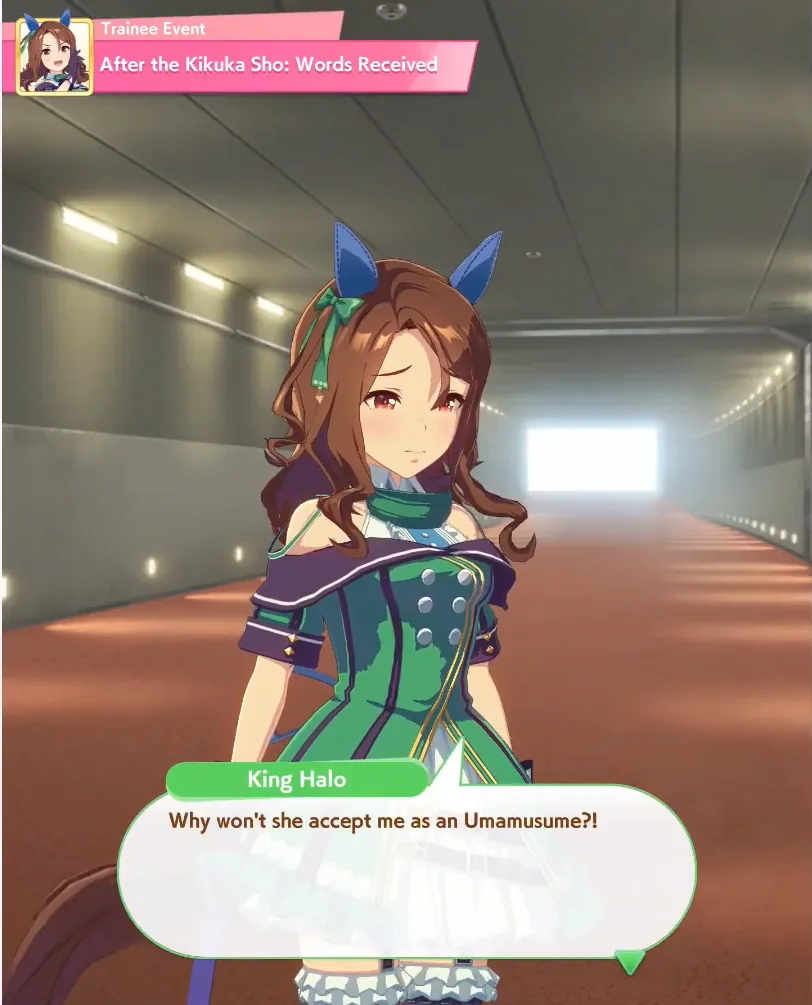
On the losing path she runs badly, the crowd cheers Special Week and Seiun Sky, nobody is looking at her, and she begins to swallow the verdict whole: in the end that person was right, I am not even a factor, this is not first-class at all. And the trainer says the thing that ends the story:
どんなに悔しいことがあっても、人々から呆れられたとしても。たとえ母親を納得させられるような結果が出せなくても――
▶ 「君は一流のウマ娘だ」 "However much it galls, however much people give up on you. Even if you never produce a result that satisfies your mother: you are a first-class umamusume."
Unconditional, present tense, forward-facing. Not you have done enough. You are this, and no outcome is required to make it true. The line arrives at a choice prompt, which means the player has to reach for it, and the narration immediately behind it refuses every term of the verdict at once:
母親とは違う、彼女だけの魅力にあふれた、才能を十分に持ったウマ娘だ。 “An umamusume unlike her mother, full of a charm that is hers alone, and possessed of talent in full measure.”
才能を十分に持った. Talent, in full measure. The exact noun her mother used to deny her, returned to her by the narration itself.
She cries, on someone’s shoulder, in front of someone, which her architecture has never permitted. The narration gives it one clause: a shoulder, lent to her until the tears stopped. The girl whose childhood was ほったらかし, being left alone, is not left alone.
Now read the two branches together, because this is the design making its argument a second time. Win the Kikuka Sho and the lesson is that total victory did not buy the thing. Lose it and the lesson is that in total failure someone who mattered called her first-class and meant it. Two opposite outcomes, one destination. The game is using its own branching to insist that the answer was never on the racecourse. No result the player can reach changes anything, because the problem was never the result.
The trainer names it, and aims at the wound rather than the tactics. She braces for him to say give up the long distances and stick to what suits you, which is a conversation about strategy. What she gets is:
「母親を振り向かせることはやめよう」 “Let us stop trying to make your mother turn around and look.”
And she lands it herself:
「私以外の誰かのための一流じゃない。私だけの……一流。」 “Not a first-class for somebody else’s sake. My own.”
Then she announces the switch to the sprint in public:
「不要な背景は捨て去るだけ。私は私だけの強さを手に入れる。」 “I will discard the unnecessary backdrop. I will take hold of a strength that is mine alone.”
背景, backdrop: pedigree, legend, mother, the entire inherited set. And she stops reaching for her mother’s 一流 and starts using 超一流, beyond first-class, a category her mother never occupied, which is to say a category that cannot be a comparison.
Note when this happens. Before the sprint. Before the win. Nothing has been proven yet. That sequence is what makes the next part mean anything.
Part 8Proof of Talent
The chapter containing her one great victory is titled 才能の証明, Proof of Talent. Given Part 7, the question is not whether she wins. It is who the proof is addressed to.
Before the race the phone rings, and the scene is staged as a deliberate inversion of every prior call. She has always taken these alone, walking away from everyone, coming back gutted. This time she has the trainer hold the phone with her and takes the call in company. Her mother says what she always says: 1200 metres is a different world, this is reckless, look at what the press are saying, you will fail.
「あら、私もプロよ。……誰でもない”キングヘイロー”としてのレースを見せてあげるから。」 “I am a professional too. I will show you a race run as nobody but King Halo.”
Then she ends the call herself. Not stormily. She simply finishes and hangs up. The discouragement fails to land because there is no longer anything on her end of the line reaching for anything.
She also accepts risk in a way the earlier version of her could not:
「たとえこの道すらも誤りだったとしても……私は後悔しない。」 “Even if this road too should turn out to be the wrong one, I will not regret it.”
That is the actual repair, stated in a throwaway line. Not certainty of winning. The ability to choose something that might fail, because the choice is hers.
She wins.
「私には……才能があった……! そうでしょう、トレーナー……っ!」 "I... had talent...! Didn't I, Trainer?!"
Read the grammar against the vow. For the entire story her sentence was お母さまに、私の才能を認めさせる: make Mother acknowledge my talent. Causative, aimed outward, requiring another person to perform an action. What she reaches at the summit is 才能があった: it was there. A statement about a fact, in the past tense, requiring nobody at all.
The noun 才能 never changes. What changes is that the sentence stops being aimed at anyone. That shift is the whole arc, compressed into a verb.
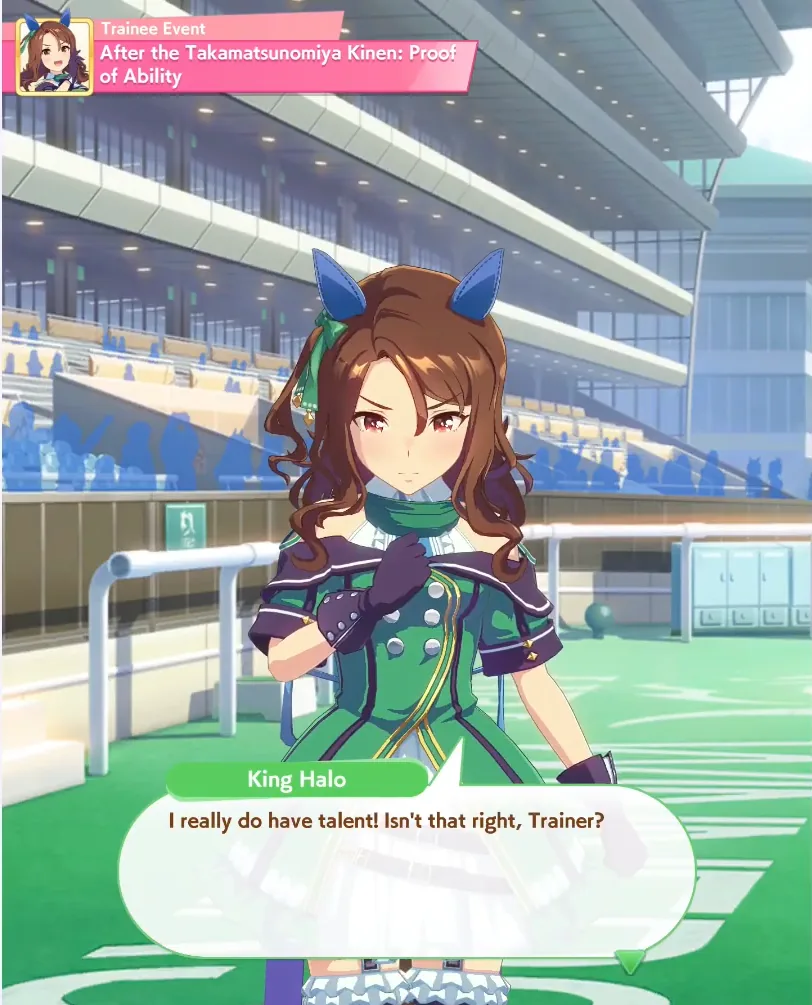
And her mother is not called, does not appear, contributes nothing. The chapter titled Proof of Talent delivers the proof and quietly changes the recipient. The only person present to confirm it is the one who was already certain, who said so before the race and while she was losing.
The absence is a decision, and it is why the story works. A reconciliation scene here, the mother in the winner’s circle, the apology, the embrace, would have retroactively converted the arc into “win her over” after eight chapters of establishing that winning her over was impossible and unnecessary. The story refuses the warmer scene to keep the true one. King Halo notes in passing that today every eye in the place is on the two of them, King and her trainer. Not the legend’s daughter. Not the young lady.
Then she breaks the cycle out loud. Kawakami Princess bursts in worshipful, vowing to chase her:
「あなたは私の背を追う必要はないのよ。あなたはあなたのなりたいもので、一流になりなさいな。」 “You do not need to chase my back. Become first-class as whatever you want to be.”
Her mother’s rejection took the form of you do not need to imitate me. King Halo takes the same shape of words and makes it a blessing, handing her junior the exact permission she was denied, in the exact grammar in which it was denied to her.
And the recognition paradox pays off in a comedy event, which is how this game hides its best material. The Fan Thanksgiving festival runs a bread-grabbing race. She goes to the front, does her grand front-running lead, and then cannot grab the bread. Repeatedly. She ends filthy and flailing while the actual contenders fight out the finish, and the entire crowd’s cheering swings to her:
「勝敗にかかわらず、応援の声を一身に受けるとは……キングちゃんのあの姿勢は、自然と人を惹きつける魅力がある。」 “To draw every cheer regardless of winning or losing. That stance of hers pulls people in on its own.”
She spent a career trying to buy that with victories. It arrives while she is covered in mud, losing badly, being ridiculously and stubbornly herself. 勝敗にかかわらず, regardless of winning or losing, is word for word the thing she once admitted she secretly wanted: a stage with no centre and no ranking, where she could stand shoulder to shoulder with everyone and simply be there. And Special Week, whose being loved she watched from outside for the whole first half, stands at the edge of this one and watches King Halo be loved.
The announcer, mid-gag, calls it her eleventh attempt at the bread. The real horse won his only Grade 1 on his eleventh attempt. The game buried his entire career in a joke about a bread roll.
Part 9What Came After
A release is only proven by what happens when the thing you let go of comes back. Two things come back.
The mother moves. After the Sprinters Stakes the phone rings, and for the first time the call does not open with a warning:
「……まさか本当に結果を残すとはね」 “So you actually went and produced results.”
She tries once more to script the path, suggesting the Mile Championship and staying in the sprint lane. King Halo refuses and names the Tenno Sho. Her mother calls her a foolish girl. And then, for the first time in the entire text, she does not say come home:
「……せいぜい勝ってみなさい」 “Win, then. If you can.”
For a woman with no warm register, who delivers everything sideways as challenge, this may be the closest thing to a blessing she owns. It may also be a sneer. The text leaves it ambiguous, as it has left everything about her ambiguous, and the placement after genuine surprise tilts it slightly toward the former without settling it.
What matters is the daughter’s reaction:
「今更、『勝ってみなさい』だなんて。……そんなの、言われなくてもだわ。」 “Telling me to win, now of all times. I do not need telling.”
The thing she would once have traded a career for arrives, and it lands as a mild and rather late grace note. It cannot re-hook her, because the healing was never contingent on it. This is the strongest possible proof that the release in Part 7 was real: her freedom does not depend on which reading of her mother is correct. She is free if it was a blessing and free if it was a sneer.
And then she says the thing she could not say in Part 4:
「私がばかな娘なら。あの人はおばかな母親よね。」 “If I am a foolish girl, then she is a foolish mother.”
似てないわよ was the panicked denial. This is the same observation held calmly, with something close to fondness. Two fools cut from one cloth. She has stopped defending herself against the resemblance, which means the resemblance has stopped being an accusation.
There is a further beat that most players will never see, and it deserves flagging as branch-locked rather than canonical. In the Arima Kinen win branch, King Halo tosses the phone to the trainer mid-call and runs off to a live performance, and her mother, not knowing or not caring who is holding the line now, says the things she has never managed to say to her daughter’s face:
「……あの子はライバルにも、トレーナーさんにも恵まれたんですね。」「本当に楽しそうな声しちゃって。今も走ることが大好きなままみたいで。」 “That child has been blessed with rivals, and with a trainer, hasn’t she. Such a happy voice. It seems she still loves running as much as she ever did.”
「……私のしてきたことは、なにもかも余計だったみたい。」 “Everything I did seems to have been unnecessary.”
The narration names the mirror explicitly: 『此の親にしてこの子あり』というべきか。『此の子にしてこの親あり』なのか, like this parent like this child, or like this child like this parent. The mother reaches her own regret, and King Halo does not hear a word of it, because she has already gone. The game gives the audience the reconciliation and withholds it from the person who earned it, which is exactly right for two people who can only speak love sideways and out of earshot. It also means the release in Part 7 stands untouched: she freed herself without ever receiving this apology.
The generation comes back. She wins the Tenno Sho (Autumn) beating Special Week and Seiun Sky, and instead of gloating she goes to find them:
「私、一時期、あなたたちのことが憎かった。……なんで私はあなたたちと、同じ年にデビューしてしまったんだろうって。」 “For a while, I hated you. Why did I have to debut in the same year as you.”
「あなたたちがいなければ、覚悟を決める機会さえ失っていた。……私と競ってくれて、ありがとう。私のライバルでいてくれて、ありがとう。」 “Without you, I would have lost even the chance to find my resolve. Thank you for racing me. Thank you for being my rivals.”
The generation that buried the real King Halo is reframed as the cause of this one. Without an impossible field to lose the classics to, she would never have been forced off the inherited road and onto her own. And it resolves the war that has run under her the whole time, between the girl who must be first and the girl who wanted to belong. Seiun Sky closes it:
「私たちはさ、同期なんだよ? これで終わるわけないじゃん。次も勝負しようよ。」 “We are the same year, aren’t we. No way this is the end. Let us race again.”
She does not have to choose. Racing them is being with them. The competition was the belonging all along, and she was the only one who could not see it, because she was too busy running at somebody to notice who was running beside her.
One correction the study owes the reader. The real King Halo did not win the Yasuda Kinen, the Sprinters Stakes or the Tenno Sho (Autumn). He ran third, third and seventh. His Grade 1 record is one line long. The victories available in this stretch are an idealisation, a version of the career in which releasing the wound also unlocked the wins reality withheld. The emotional arc is faithful to the character. The trophy cabinet is not faithful to the horse, and letting the two blur would be selling a nicer story than the one that happened.
Part 10The Inheritance
Her support card 我が舞、巡りて, my dance, coming full circle, opens with a poem. She is teaching a dance, correcting the chin, the neck, the fan, the spine, and then:
私の言葉は、あなたに根を張り、あなたに息づく。あなたが舞うときは、私もまた、心の中で舞っている。だから――あなたに、託すの。 “My words take root in you and breathe in you. When you dance, I am dancing too, inside. So I entrust this to you.”
Set that against her mother and the character finishes.
Her mother once told her that clothes are how the heart dresses itself and a noble colour makes the heart noble. King Halo built a life on it, and says in a home line that her mother has surely forgotten she ever said it. Her mother also told her, when she was small, that green suited her, and she still races in green and deflects the compliment in the same breath she recalls it. That is the asymmetry of the entire relationship: the parent’s throwaway becomes the child’s foundation, and the parent does not remember laying it.
託す, to entrust, is the correction. Teaching, King Halo articulates what her mother could never manage: I know my words live inside you, I am with you when you perform, and I am handing this over deliberately. Nothing accidental. Nothing forgotten.
The mechanism is not instruction. It is being watched while refusing to quit. She claims she can cook, cannot, burns the fried rice black, and keeps going. Mayano Top Gun tells her not to push so hard on her account:
「これは、私のためよ。一流たるもの、できないからでは引き下がれないのよ。――でないと私は、私を誇れない。」 “This is for me. First-class does not retreat just because it cannot do something. Otherwise I cannot be proud of myself.”
Mayano falls asleep and learns no cooking whatsoever, and reports that she worked out what first-class means anyway. Machikane Tanhauser asks her to style a monster figurine, outside every competence she has, and she researches it from scratch for days, because 期待、してくれたんだもの, because somebody expected something of me, and answering that is what first-class is.
Then the payoff, in the chapter literally titled 相伝, transmission. Kawakami Princess and Haru Urara are building a birdhouse and making a mess of it. King Halo offers to help, and Kawakami refuses her:
「お2人は言っていました。キングさんから――”諦めない”を、教えてもらったと。」「ですから私、まだ諦めたくないんです。――キングさんのように!」 “They both said the same thing. That you taught them not to give up. So I do not want to give up yet either. Like you.”
諦めなさい. Give up. That was the instruction in every phone call, the sentence the entire persona was built to survive.
諦めない. Do not give up. That is what she transmits, without teaching it, simply by being observed failing at fried rice and refusing to stop.
The inheritance she received was a verdict. The inheritance she passes on is its exact inverse, given consciously and named as a gift. She could not get what she needed from above, so she became the source of it for everyone below. The card ends on her watching the birdhouse she was not allowed to help build:
「……見てごらんなさい。元気になったヒナたちが、いまにも飛び立ちそうでしょ? 本当に……あっという間に、成長しちゃうのよね。」 “Look at them. The chicks are strong now, about to fly. They really do grow up in no time at all.”
Fledglings leaving a nest somebody else built, watched by the one who taught them how and has no part in it.
The pattern repeats once you can see it. Kawakami is ashamed that training has made her shoulders unprincesslike, and King Halo tells her 「”らしさ”だなんて、千差万別じゃない」, there are a thousand ways of being like yourself, and that the muscle is evidence of effort toward her own goal, and denying it would be foolish. That is precisely the permission she was refused, given away free. She opens that same conversation with 「1人で抱え込むよりも、多少はマシでしょ」, better than carrying it alone, which is a sentence from a girl who carried everything alone.
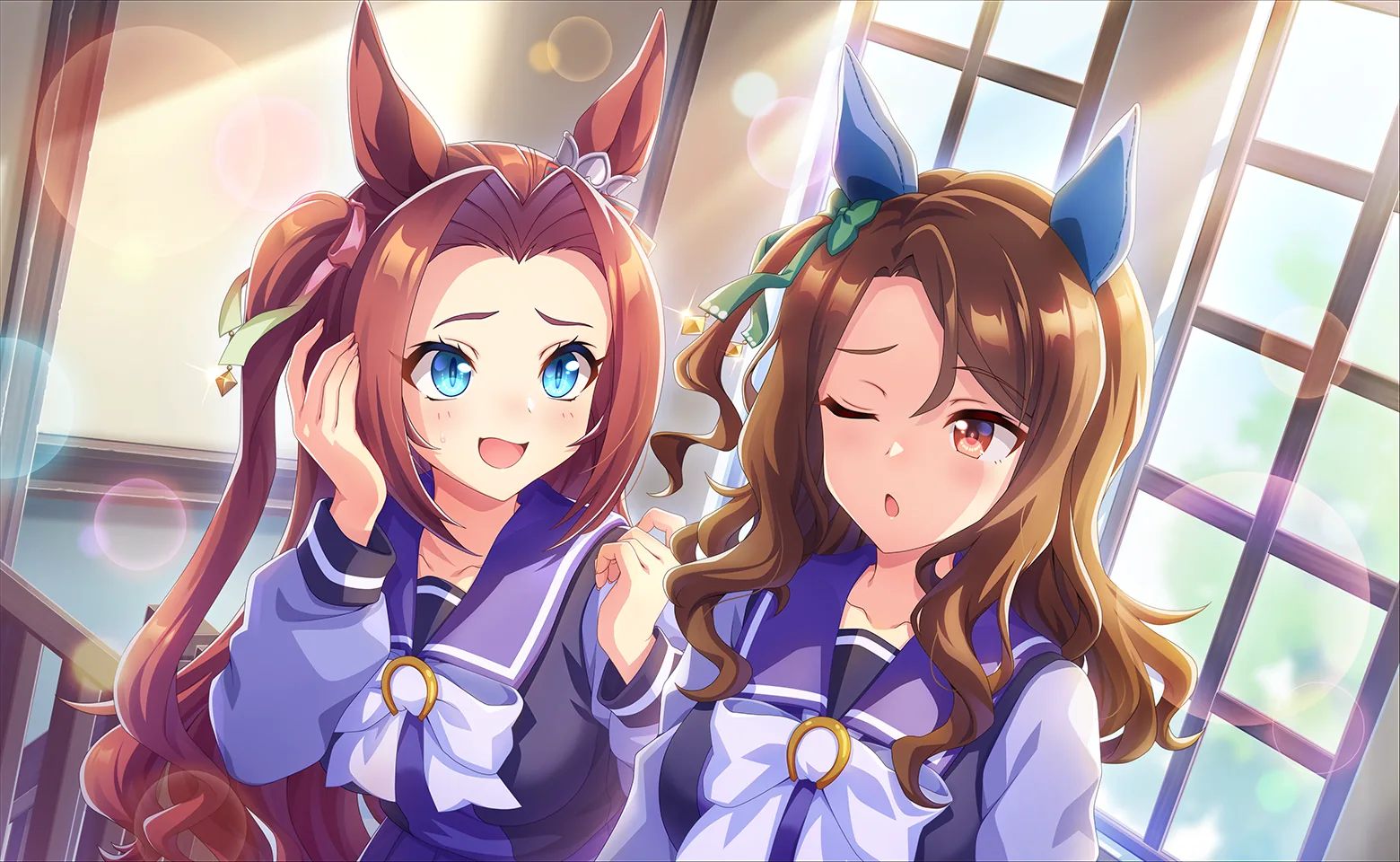
Even her shopping card runs on it. It is titled 私のためのショッピング, shopping for me, and its monologue is almost entirely her buying things for other people: a handkerchief the colour of Urara’s eyes because Urara keeps forgetting hers, a return gift for Kawakami’s burnt cookies, hair clips because two friends started eating ramen without tying their hair back. She is a caretaker who can only file caretaking under self-indulgence. It is her mother’s deflection, running in the opposite direction.

Part 11The Last Race
The career story ends with a documentary crew. She tells them to be sure to film her victory.
Then she loses.
This is the choice that makes the ending honest. The game let the player win the Takamatsunomiya, the Yasuda, the Sprinters, the Tenno Sho. The final race it chooses to show you, in the closing scene of the entire story, is a defeat, on camera, in front of the crew she invited specifically to record her winning.
「こんな結果になってしまったけど、それが今の私であることに変わりないもの。」 “The result turned out like this, but that does not change that it is who I am right now.”
「どのような現状でも、潔く認める。全てを糧にして、私は歩み続けるわ。」「それでこそキングなのよ。」 "Whatever the state of things, I own it cleanly. I will make all of it my nourishment and keep walking. That is exactly what makes me King."
潔く認める. To acknowledge it without flinching.
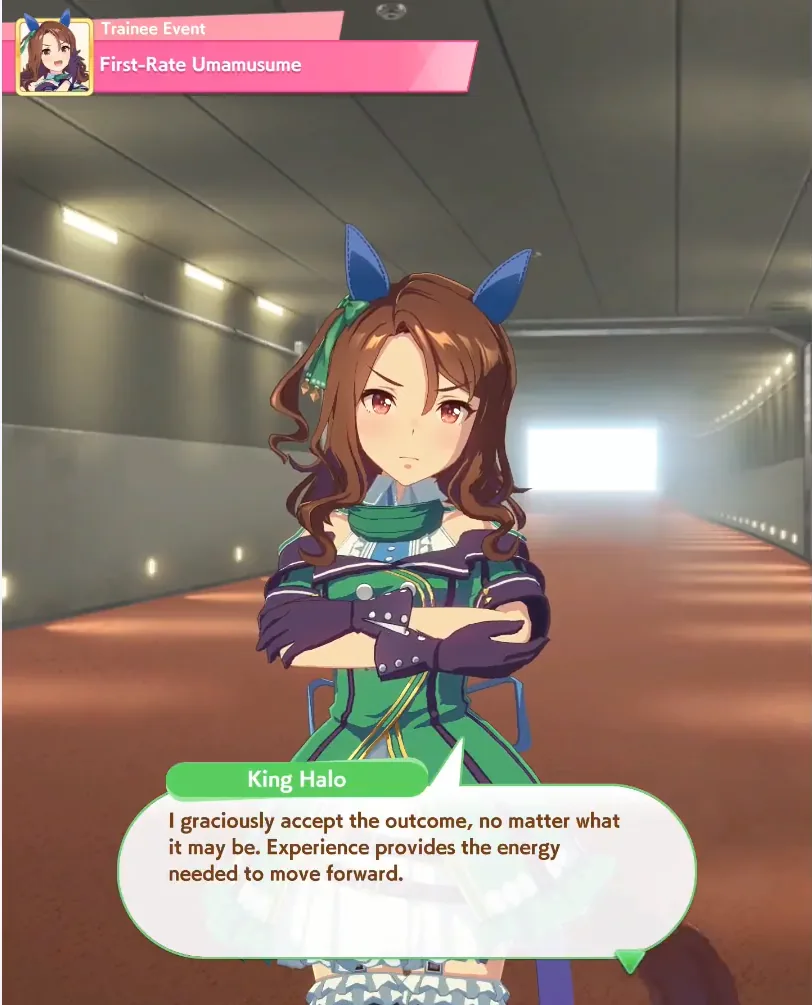
Weigh that against everything. Against the woman who ate the failed cake alone so nobody would see it. Against the girl who re-drilled a stumble nobody noticed. Against her own earlier and only half-joking rule, 認めなければ失敗じゃない, if I do not acknowledge it, it is not a failure.
She loses in public and stays whole. She does the one thing her mother could never do, which is to be seen failing and not be destroyed by it. The armour both women wore, the pride that could not survive a witness, comes off, and the pride itself survives. That is the actual repair: not that she stopped being proud, but that pride and honesty stopped being incompatible.
And the legend finally means nothing:
「私は、天才が相手だろうが、伝説が相手だろうが関係ないの。」 “Genius across from me or legend across from me, it makes no difference now.”
伝説, the legend. She is no longer running against her. She is simply running.
Then the narration reveals the second thing that quietly pleased her about the documentary, and the thesis arrives in the last frame:
「”誰かの娘”という呼び方はなく、『一流のウマ娘』として。」 “Not called ‘somebody’s daughter,’ but as a first-class umamusume.”
That is the object of the whole story, named at last. Not a trophy. Not her mother’s approval. Her own name, said as hers, by people who were not thinking about anyone else when they said it. The film is titled 『一流ウマ娘、キングヘイロー』.
She laughs the laugh, exactly as always. The wound closes and the personality survives it intact.
Part 12The Through-Line (Synthesis)
Walk the whole detour back from the finish, and every wrong turn lines up.
King Halo was handed a verdict by the only person qualified to deliver it. Absent through her childhood, and then, when it counted, certain: you have no talent, give up, you would be happier elsewhere. Because that ruling could not be dismissed it had to be walled off, and the wall is the persona: King, first-class, the drilled laugh, the rehearsed posture, the crown announced daily to anyone within earshot. The loudness is proportional to the fear, and the text says so the first time it lets us behind her: her eyes were wavering.
The first cruelty is that the wall was built from the material it was built against. To defy her mother she became proud, competitive, unable to be witnessed failing, fluent only in the language of achievement. She became her mother, which is why she cannot stop running at her, and why 似てないわよ comes out as a reflex. Her defiance was a form of inheritance.
The second is that the currency was never accepted. Win the Derby and it is luck. Win the final crown and it is time to come home. The branch structure exists to prove that no result would have counted, which makes the entire career an attempt to settle a debt in a coin the creditor does not take.
The third, and the one that lifts her from wounded to tragic, is that she knew where her talent actually was and refused it. She is a sprinter. She was told so, agreed, and forbade anyone from saying it, because a sprint win would not serve the wound and would mean admitting she was not her mother’s echo. Her talent pointed one way and her wound pointed the other, and the wound won for most of her life.
What breaks the deadlock is not a victory. It is a witness: someone who says, while she is losing, that she is first-class regardless of any result her mother would accept, and who then stays. The release happens before the great win, which is the only reason the great win means anything. And when the proof comes it has changed address. Not make her acknowledge it, but it was there. The word holds. The recipient disappears.
Everything after is the shape of a person who has stopped needing something. Her mother softens and it lands as a pleasant irrelevance. The rivals who buried her are thanked for burying her. The recognition she could not purchase arrives free while she is losing a bread race covered in mud. And what she was denied, she starts handing out: to Kawakami Princess, explicitly freed from having to chase her; to juniors who learn from watching her fail and refuse to quit; to children whose parents write in hoping they will pick up her 諦めない走り, her running that does not give up. The girl commanded to give up became the person from whom everyone learns not to.
She does not become serene. She is still vain, still loud, still demanding the spotlight back from a younger champion in the closing chapters, still incapable of grabbing a bread roll with any dignity whatsoever. That is a more honest picture of recovery than the version where the hurt person turns wise and quiet, and it is why she is worth this much attention.
The last word belongs to the horse. He was named for a destiny before he could stand, lost the race he was bred to win, ran distances nobody could agree on, never once beat his great rival, and took a single championship at the eleventh attempt in the discipline his pedigree least predicted, and then went on losing. His bloodline vindicated the pedigree a generation late, in other names. The game takes that record and finds the only reading of it that is both true and bearable: the detour was not a failure to arrive. It was the road.
「誰かの跡をなぞるでもなく、私だからできた壮大な……回り道で。」 "Not tracing anybody's footsteps. A grand detour that only I could have taken."
Appendix, Lines Worth Keeping
The lines that held the wall up, and the ones that took it down, with sources. Career-mode material that depends on a branch is flagged; it should not be read as the single canonical outcome.
| Line (JP) | Translation | Source |
|---|---|---|
| 一流のウマ娘として最高の結果を残すわ | As a first-class umamusume I will leave nothing but the finest results | Self-introduction |
| あなたに走りの才能は無い。諦めなさい | You have no talent for running. Give up | Character Story (the mother) |
| 現役中も、引退して仕事を始めてからも、私のことはほったらかしだった | While she was racing and after she retired, she left me to fend for myself | Character Story |
| 恥をかく前に帰ってきなさい | Come home before you embarrass yourself | Career, post-debut call |
| 自信を語る言葉とは対照的に、彼女の瞳は揺れていた | Against her confident words, her eyes were wavering | Career, narration, post-debut |
| 私は”一流のキングヘイロー”を名乗り続けるわ。決して首を下げない | I will keep calling myself first-class King Halo. King never lowers her head | Character Story |
| いかに人に気づかれなかったとしても、失敗は失敗よ。私は私が許せないわ | However unnoticed it went, a failure is a failure. I could not forgive myself | Character Story (the Winning Live stumble) |
| 私には翼があるから。生まれ持った才能という翼が | Because I have wings. The wings of talent I was born with | Random event (loss) |
| あの子たちには内緒にしてて | Keep it from them | Random event, 頭痛で憂鬱 |
| 悔しいけど、あの人は一流よ | It galls me, but that person is first-class | Character Story (the mother’s work) |
| 私には服なんて、一切作ってくれなかったけど | Though she never made me a single thing to wear | Character Story |
| 似てないわよ! | We are NOT alike! | Character Story (to the trainer) |
| ただ、風邪で休んだ後輩たちをどう叱ってあげようか考えてただけ | I was only working out how to scold the juniors who came down sick | Random event, キングの心配事 |
| 『認められるためだけに走る』のか? | Do you run only to be acknowledged? | Career, Air Groove |
| せっかく運よく勝てたのだから、メッキがはがれる前に引き返した方がいいわ | Since you won on luck, turn back before the plating flakes off | Career, Derby (win branch) |
| あの子には期待してくれる母親がいるのね | So that girl has a mother who believes in her | Career, Derby (on Special Week) |
| たった1度の走りだけで、あの2人は名前すらも呼ばれるのね | One run, and those two even get called by name | Career, summer camp |
| 彼女の武器は…残す脚ではなく一瞬で出し切る脚 | Her weapon is everything spent in one instant | Career, 私の脚 (narration) |
| わかってるの。だけど、それを話す権利を、あなたにあげられない | I know. But I cannot give you the right to say it out loud | Career, 私の脚 |
| これでもう、いいんじゃない?……帰ってきなさい | That is enough now, surely. Come home | Career, Kikuka Sho (win branch) |
| どうして『次のレース楽しみにしてる』って、言ってくれないの | Why will she not just say she is looking forward to my next race? | Career, Kikuka Sho (win branch) |
| たとえ母親を納得させられるような結果が出せなくても――君は一流のウマ娘だ | Even if you never satisfy your mother, you are a first-class umamusume | Career, Kikuka Sho (loss branch; choice prompt) |
| 母親とは違う、彼女だけの魅力にあふれた、才能を十分に持ったウマ娘だ | Unlike her mother, full of a charm that is hers alone, with talent in full measure | Career, Kikuka Sho (loss branch; narration) |
| 母親を振り向かせることはやめよう | Let us stop trying to make your mother turn around and look | Career, post-Kikuka |
| 私以外の誰かのための一流じゃない。私だけの……一流 | Not a first-class for somebody else’s sake. My own | Career, post-Kikuka |
| 不要な背景は捨て去るだけ | I will discard the unnecessary backdrop | Career, the sprint declaration |
| たとえこの道すらも誤りだったとしても……私は後悔しない | Even if this road too should be the wrong one, I will not regret it | Career, pre-Takamatsunomiya |
| 私には……才能があった……! | I… had talent…! | Career, 才能の証明 |
| あなたは私の背を追う必要はないのよ | You do not need to chase my back | Career, to Kawakami Princess |
| 勝敗にかかわらず、応援の声を一身に受けるとは | To draw every cheer regardless of winning or losing | Career, Fan Thanksgiving (Grass Wonder) |
| ……せいぜい勝ってみなさい | Win, then. If you can | Career, post-Sprinters (the mother) |
| 私がばかな娘なら。あの人はおばかな母親よね | If I am a foolish girl, then she is a foolish mother | Career, post-Sprinters |
| あなたたちがいなければ、覚悟を決める機会さえ失っていた | Without you, I would have lost even the chance to find my resolve | Career, Tenno Sho (Autumn) |
| 私のしてきたことは、なにもかも余計だったみたい | Everything I did seems to have been unnecessary | Random event, Arima Kinen (win branch; the mother, unheard) |
| 『此の親にしてこの子あり』というべきか | Like this parent, like this child? | Random event, Arima Kinen (narration) |
| あなたに根を張り、あなたに息づく……あなたに、託すの | It takes root in you and breathes in you. I entrust it to you | Support card, 我が舞、巡りて (intro poem) |
| これは、私のためよ……でないと私は、私を誇れない | This is for me. Otherwise I cannot be proud of myself | Support card, 我が舞、巡りて |
| キングさんから――”諦めない”を、教えてもらった | You taught us not to give up | Support card, 相伝編 |
| “らしさ”だなんて、千差万別じゃない | There are a thousand ways of being like yourself | Support card, 一流プランニング |
| どのような現状でも、潔く認める。全てを糧にして、私は歩み続けるわ | Whatever the state of things, I own it cleanly. I will make all of it my nourishment and keep walking | Career, finale (after a loss) |
| 意地を張らずに失敗したって言えばいいだけなのに | She could just drop the stubbornness and say she failed | Character Story (on her mother’s hidden cake) |
| “誰かの娘”という呼び方はなく、『一流のウマ娘』として | Not called ‘somebody’s daughter,’ but as a first-class umamusume | Career, finale |
| 誰かの跡をなぞるでもなく、私だからできた壮大な……回り道で | Not tracing anybody’s footsteps. A grand detour only I could have taken | Random event, 王様のSMILE |
Translations are working renderings aimed at preserving meaning and register; the Japanese is the authority.